Why is pea protein not as good as whey?
The functional incompleteness of pea protein powder compared to whey protein in some formulation and nutritional engineering applications is attributed to variations in the amino acid composition, solubility characteristics, and processing ability in liquid systems.
Pea Protein Powder vs Whey Protein Powder: Core Composition Differences
Pea Protein Powder structural characteristics
Plant protein matrix – Lectin protein, which is naturally different from milk-based protein.
Amino acid distribution – Usually lower in some of the rapidly available essential amino acid fractions than in whey systems.
Molecular structure – Dispersion and solubility behavior may be affected by more complex plant protein aggregation.
The advantages of the structure of whey protein (context)
Protein fraction of dairy – Naturally optimized for high solubility and speedy dispersion.
High purity isolates – These are often processed to give a very uniform distribution of protein.
Smooth hydration profile – smoother incorporation into liquid systems, without much processing support.
Functional Performance in Food Systems
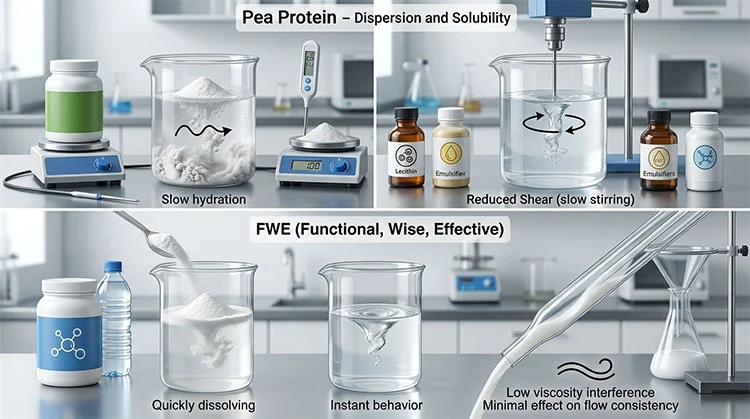
Pea Protein Powder dispersion and solubility
Rate of hydration – Slower in cold liquid systems than with whey.
Interactions between particles – Greater propensity to aggregation under reduced shear.
Processing dependency – May need emulsifiers or hydrocolloids for “best” performance.
The FWE of whey protein.
Rapid dissolution in aqueous systems – instant solubility behavior.
Low viscosity interference – Little effect on drink consistency.
High formulation simplicity – Less need for additional stabilizing systems.
Industrial Formulation Design
Pea Protein Powder formulation constraints
Flavor masking requirement – Notes derived from plants may need more design in the flavor system.
Texture balancing – May require co-ingredients to obtain a smooth mouthfeel.
System compatibility – Best suited to multi-ingredient systems rather than Single protein systems.
The benefits of whey protein formulation are: Whey protein formulation benefits:
Neutral flavour integration – more easily added to a variety of products.
Smooth texture profile – Makes a smoother liquid consistency and requires fewer adjustments.
Greater formulation tolerance – works over a variety of pH and temperature.
Processing and Manufacturing Behavior
Pea Protein Powder processing sensitivity
Thermal response variation – Needs to be controlled to keep the texture stable when heated.
Shear dependency – better performance under high shear mixing conditions.
Batch variability management – Needing to standardise industrial output.
The stability of whey protein during processing.
Heat stability range – More consistent behavior in typical food processing conditions.
Low aggregation tendency – Less clumping during processing.
Cost reduction – Lower costs of installation.
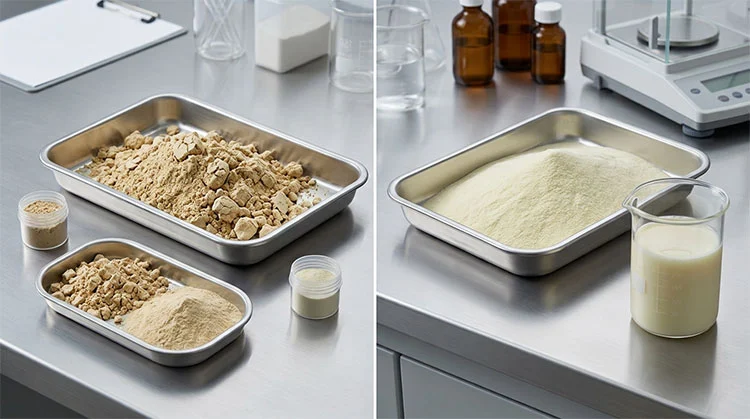
Application Optimization Strategies
Pea Protein Powder blending approaches
Protein Blending Systems – Usually used in conjunction with rice or oat protein to balance performance.
Functional additives – Usually used in combination with stabilisers to enhance dispersion.
System engineering – Optimization of formulation for texture and mouthfeel.
Whey protein is an additive without any other ingredients. Whey protein as a standalone additive.
Monoculture efficiency – can work well without a lot of mixing.
High Performance Baseline – lower number of auxiliary ingredients.
Direct application versatility – Applicability to much more varied, simplified product designs.
Market Positioning in Comparison
Pea Protein Powder positioning factors
Plant-based positioning – Clear linkage to vegan and plant-forward positioning of products.
Dairy-based protein sourcing diversification – Used to diversify the dairy-based protein supply chain.
Development of clean label – Supports today's consumer demand for transparency.
The positioning factors of whey protein
Reliable and widely used benchmark for protein formulation industries.
High familiarity with products – Products are well recognized by consumers.
Functional premium positioning – This is sometimes regarded as a reference product in a category for functional products.
Why is pea protein not as good as whey?
In absolute terms, pea protein powder is not necessarily poor; however, it exhibits a different functional behaviour, different solubility behaviour, and different formulation efficiency compared to whey protein. Whey protein typically provides better formulation properties for use in liquid systems in industrial applications and is easier to integrate into liquid systems, whereas pea protein needs to be engineered and blended to match the whey protein in terms of the desired texture and dispersion properties. Nevertheless, the significance of pea protein for today's manufacturing has not diminished, as it keeps being considered as one of the most suitable protein sources for composite formulations and is perfectly aligned with clean-label and sustainable ingredient strategies.
When you are in need of good quality products that are reliable in nature, then you get no better deal than ours. You can reach out to us directly at info@scigroundbio.com or fill in the form at the end of the page, and our prompt team will get in touch with you with packed product information, pricing details, and help you with order placement to fulfill your business goals.
FAQ
Q1: Why is pea protein powder harder to dissolve than whey protein?
It is due to its protein structure, based on a plant, which is different in water absorption and aggregation from dairy-derived whey proteins.
Q2: Can pea protein powder replace whey protein in formulations?
Yes, but this is frequently a blending/formulation challenge to ensure the same levels of both solubility and texture and flavour performance.
Q3: What is the main formulation challenge of pea protein powder?
The most difficult aspect is being able to disperse the material and integrate the flavor into the liquid system without causing any issues.
Q4: Why is whey protein considered more “efficient” in manufacturing?
It tends to dissolve more rapidly, is more easily incorporated, and does not need as many other formulation aids.
References
1. Day, L. (2021). Plant proteins in food systems: structure and functionality. Trends in Food Science & Technology, 108, 28–39.
2. Lam, A. C. Y., Karaca, A. C., & Nickerson, M. T. (2020). Functional properties of pea and dairy proteins: A comparative review. Food Hydrocolloids, 99, 105328.
3. He, R., et al. (2022). Comparative functionality of plant and animal proteins in food systems. Journal of Food Engineering, 317, 110874.
4. FAO. (2021). Protein quality and sustainable food systems. Food and Agriculture Organization of the United Nations.
5. Boye, J. I., et al. (2020). Pulse proteins: functionality and industrial applications. Critical Reviews in Food Science and Nutrition, 60(13), 2199–2224.
You may like