Which is better, stevia or allulose?
While there is a clear distinction between the formulation applications of Stevia and Allulose, the type of application that is most suitable is dependent on the product category, sweetness target, product texture, and manufacturing goals.
Stevia vs Allulose is increasingly important in the modern food and beverage development landscape, serving as a doorway to new, innovative sweetening ingredients compliant with evolving market demands. Both ingredients are commonly used in commercial products, but have different functional properties. Stevia powder is an "intense" sweetener made from the leaves of the stevia plant, while allulose powder is a rare sugar ingredient that has a "sugar-like" sweetness. While sweetness is a key factor for food manufacturers, there are other factors to consider, like taste performance, processing qualities, texture, application compatibility, and final product positioning.
Stevia vs Allulose: Differences in Sweetness Characteristics
Sweetness Intensity and Taste Profile
The biggest difference between stevia and allulose is how much sweetener they contain and the sensory effect they have.
Stevia: Stevia extracts are composed of steviol glycosides to give intense sweetness, and very little of the extract needs to be used in any formulations. However, you may need to take into account the flavor aspects—manufacturers must consider the balance of flavor aspects as they may affect how a sweetener is perceived after it is eaten.
Allulose: Allulose powder is less sweet than stevia, but has more of a "sugar-like" flavor.
For product developers, it will depend on whether the formulation will need to be sweetened and have a concentrated profile, or be a sugar-like profile.
Allulose Powder vs Stevia Powder in Food Formulations
Application Flexibility in Manufacturing
Although they have wide industrial uses, allulose powder and stevia powder are used in different ways.
Allulose powder applications: High demand for allulose powder in a variety of food categories can be seen in baked goods, beverages, frozen desserts, dairy alternatives, sauces, and powdered food blends where manufacturers have a demand for sweetness, along with texture and processing attributes.
Stevia powder uses: Commonly used in beverages, nutritional supplements, confections, and powdered mixes which call for high sweetness intensity and little addition of ingredients.
Full formulation is more often than not the way that manufacturers assess a sweetener.
There is a difference between texture and mouthfeel. Texture is different from Mouthfeel Considerations.
One important consideration in the comparison of allulose and stevia for food production is their texture performance.
Allulose: Due to its structural similarities to sugar, it may also help to provide bulkiness, mouthfeel, moisture interaction, and texture in specific formulations.
Stevia: A very sweet compound, so it can be used to provide sweetness but has no substantial bulk or structural properties.
Allulose can provide other formulation benefits in bakery, frozen applications, and in dairy, due to its interactions with the product matrix.
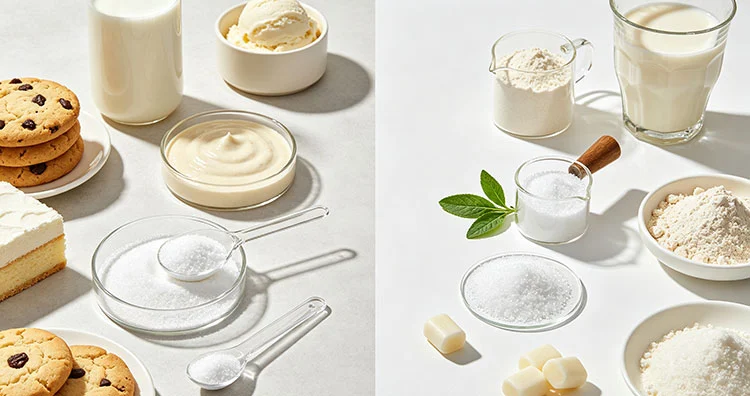
Formulation Strategy: Combining Stevia and Allulose
Sweetener Blending for Optimized Results
Many commercial stevia sugar manufacturers opt not to use stevia alone, but instead use a blend of both, which can be used together to provide optimal product performance.
Sugar-like base: Allulose can be used to give a sugar base, and stevia can be used for the intensity of sweetness.
Flavor adjustment: Using a combination of sweeteners enables the formulator to control more effectively the sensory properties.
Commercial feasibility and cost management: Combining ingredients may enable manufacturers to obtain desired levels of sweetness without exceeding their commercial feasibility or increasing the cost.
Sweetener blends are gaining popularity for use in beverages, nutrition, and specialty food products.
Heat, Storage, and Manufacturing Performance
Allulose powder or Stevia powder for industrial uses needs to be considered with respect to processing conditions.
Allulose stability: Allulose is suitable for a variety of heat-processed applications such as bakes and cook processes; however, formulation-specific conditions should be assessed.
Stevia stability: Most beverages and dry mixes applications have acceptable stability of stevia extracts, particularly when correctly formulated with the appropriate ingredients.
Storage factors: These ingredients need to be packaged and stored properly, with controlled moisture levels and warehouse management to maintain their quality.
Pilot trials are generally done by the large-scale manufacturers before actual commercial production.
Choosing Between Stevia and Allulose for Different Products
Product Category Determines the Better Choice
The choice of ingredients will be a very crucial one, depending on the final product design.
Beverages: Stevia can be a sweetness option in applications where intense sweetness is needed, whereas allulose could be used to balance the sweetness profile and formulation.
Use in bakery products: Allulose is suitable for use where the sugar-like functionality, browning, and texture development are relevant.
Powdered blends: These ingredients can be used alone or in combination, depending on the desired sweetness level and formulation.
Premium food products: Manufacturers can choose to use different combinations of ingredients to ensure that the taste of the food meets a specific goal and/or be labeled as such.
Industrial Purchasing Considerations for Allulose and Stevia
Supply Chain and Customization Requirements
For B2B buyers, there are also commercial considerations relating to ingredient selection.
Availability of specification: Manufacturers need to take into account purity standards, particle sizes, packaging, and documentation needs.
Application support: Technical support will enhance production efficiency when developing the application.
Stability of supplies: Sourcing partners and partners with long supply chain experience are essential to supply the goods of consistent quality over several production batches.
Which is better, stevia or allulose?
To sum up, both stevia and allulose are not necessarily superior; it comes down to the traits of the product desired as well as manufacturing requirements. Stevia offers a high-intensity sweetness at a low usage, while allulose powder is a more sugar-like sweetness experience that also has formulation benefits. Allulose and stevia can be blended to deliver a balance of taste, texture, process, and market differentiation for many commercial applications, particularly for innovative food and beverage development.
You may contact us directly here: info@scigroundbio.com, or you may just write your requirement in the form available on our site. Our source is dependable, our delivery rapid, and our pursuit of business diligent and professional.
FAQ
1. Is allulose better than stevia for baking products?
Allulose is also more appropriate for baking applications as it can interact with texture, moisture, and browning characteristics, while stevia will only add sweetness.
2. Can stevia and allulose be used together in food formulations?
Yes, many commercial products are using a mixture of the two. Sweetener blends are frequently used by manufacturers to provide an intensity of sweetness, flavor, and functionality to the product.
3. Which is better for beverages, stevia or allulose powder?
The selection will vary according to the formula of the beverage. Both Stevia and allulose powder can be used in low quantities to impart strong sweetness, while allulose powder might offer a softer sweetness and better mouthfeel properties.
4. How do manufacturers choose between pure allulose powder and stevia extract?
The selection of sweetener depends on the manufacturer on a variety of factors, including product category, sweetness target, processing conditions, ingredient compatibility, cost, and desired consumer experience.
References
1. Zhang, W., Yu, S., & Zhang, T. (2021). Rare sugars and their applications in food industry: Production, properties and functional perspectives. Food Chemistry, 344, 128671.
2. Grembecka, M. (2022). Natural sweeteners in food applications: Trends, technologies and formulation considerations. Foods, 11(18), 2806.
3. U.S. Food and Drug Administration. (2020). Guidance and regulatory considerations for the labeling of allulose in food products. U.S. Food and Drug Administration.
4. International Food Information Council. (2023). Consumer perspectives and market trends in sugar reduction and alternative sweetener ingredients. Food & Beverage Industry Report.
You may like