What is organic fertilizer?
Organic Fertilizer is an amendment to the soil that has been produced by biological means, such as using plant residues, animal by-products, composted organic matter, and microbial fermentation products, and is designed to enhance soil fertility and nutrient cycling systems.
It is applied to soil in modern farming as a formulated nutrient addition that fosters soil organic matter, improves nutrient-pooling potential, and aids soil productivity for extended soil management periods within various production systems.
Organic Fertilizer Composition and Raw Material System
Organic fertilizer raw material sources
Organic fertilizers are created from a variety of biological components, which define their nutrient makeup and functionality.
Plant-based residues
Providing carbon-rich organic matter for soil improvement from crop straw, oilseed meal, and plant fibre waste.
Animal-derived materials
Composted manure, bone, and protein residues that provide nitrogen and mineral elements.
Microbial fermentation inputs
Created by controlled fermentation systems that transform the organic waste into stable humified compounds.
Humic substance concentrates
Enhanced nutrient-binding and soil structure stability from natural leonardite or plant decomposition processes.
Organic Fertilizer Nutrient Mechanism in Soil Systems
Nutrient release behavior in organic fertilizer
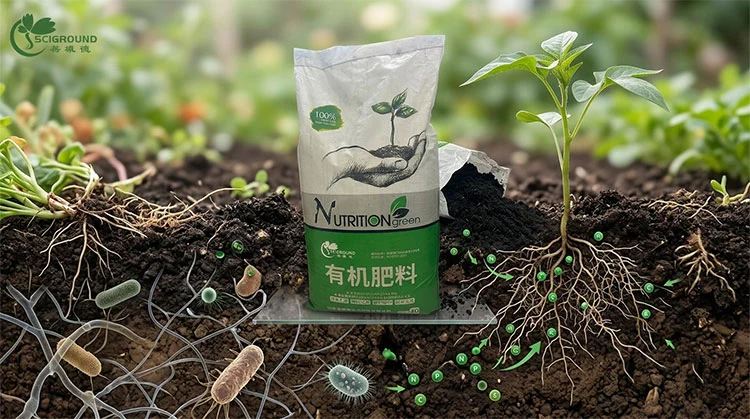
Slow decomposition and microbial mineralization processes are the mechanisms by which organic fertilizer works.
Gradual nutrient release
Nutrients are released gradually with the degradation of organic matter, minimizing nutrient loss.
Microbial activation process
Enzymatic activity of soil microorganisms breaks down organic compounds to make nutrients available to plants.
Carbon-based nutrient buffering
Organic carbon helps to maintain nutrient availability and minimise fluctuations in soil nutrient levels.
Retention of nutrients in the soil
Raises the cation exchange capacity (CEC), thereby increasing the soil's nutrient-holding capacity for various soil types.
Organic Fertilizer Formulation Techniques and Optimization
Key formulation strategies in organic fertilizer production
The focus of modern organic fertilizer development is the balance of nutrients and biological activity.
NPK balancing adjustment
Managed N, P, and K application in accordance with the plant growth phase.
Humification control process
Helps to stabilize organic matter to create humic substances that will help the soil to condition itself for the long term.
Microbial inoculation integration
Incorporation of strains of beneficial bacteria for rapid organic decomposition and nutrient cycling.
Additive synergy design
Mining and mixing amino acids, organic acids, and trace minerals to optimize the efficiency of nutrient absorption.
Organic Fertilizer Application Methods and Usage Systems
Field application techniques of organic fertilizer
The efficiency of the nutrient and soil interaction performance is dependent on application methods.
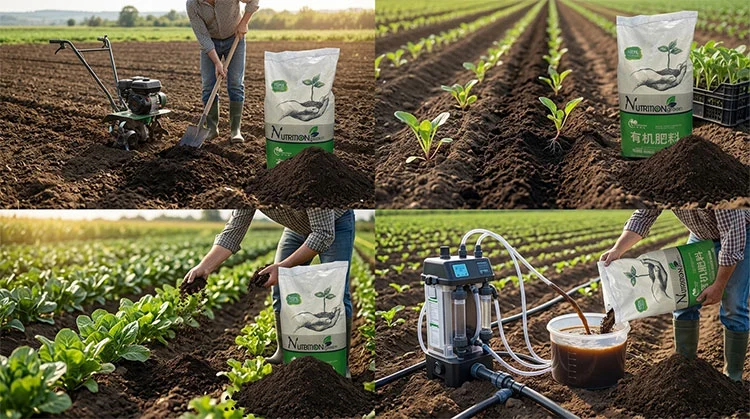
Basal soil incorporation
Mixed in soil layers and applied before planting to create nutrient reserves.
Band placement application
Targeting nutrients to areas close to the root zones to maximize uptake during early establishment.
Top dressing supplementation
Used throughout the crop growth stages to provide a continuous nutrient supply.
Fertigation-compatible systems
Several liquid organic products are applied using irrigation systems to get a uniform application.
Organic Fertilizer Stability and Environmental Performance
Physical and biological stability characteristics
The stability of organic fertilizers is determined by the degree of processing and the type of microorganisms in the fertilizer.
Stability of the organic matter.
Well-composted materials will have less volatility when decomposing and will have better storage performance.
Moisture balance regulation
Appropriate drying and granulation will minimize clumping and the risk of nutrient degradation.
Microbial equilibrium maintenance
Excessive fermentation during storage is prevented by the balanced microbial communities.
Soil ecological compatibility
Promotes long-term soil biodiversity and ecological balance in agriculture.
Organic Fertilizer Industry Applications and Crop Systems
Agricultural application scenarios of organic fertilizer
Organic fertilizer is used in various farming methods.
Systems for integrating field crops.Field crops integration systems.
Incorporated into the soil for grain and oilseed production to enhance soil structure and yield stability.
Horticultural crop systems
Promotes vegetables and fruits; improves nutrient availability and water holding capacity.
Perennial crop management
Maintained in orchards to keep the soil healthy and productive over time.
Specialty crop cultivation
Applied to medicinal and functional crops with more stable nutrient demands and growth requirements.
What is organic fertilizer?
Organic fertilizer is a nutrient system that is derived from the biological processes of slow nutrient release, microbial activity, and soil structure improvement to improve long-term agricultural productivity. It is dependent on the raw material composition, formulation design, application strategy, and behaviour of interaction with the soil. Organic fertilizers can be used in various farming contexts to promote soil fertility and sustainable crop production by combining and interacting with organic matter and microbial systems, and a balanced nutrient composition.
To learn more about our products and services, please contact us at info@scigroundbio.com. Let us help you nurture your farm with the power of science-based organic nutrition.
FAQ
1. What is organic fertilizer used for in agriculture?
The use of organic fertilizer to add organic matter to soil, increase nutrient cycling, and promote adequate plant growth.
2. How does organic fertilizer release nutrients over time?
It releases nutrients by means of microbial decomposition of organic substances, providing a gradual and sustained nutrient supply in the soil.
3. What are the main factors affecting organic fertilizer effectiveness?
The effectiveness is dependent on the quality of the raw materials, the composting process, microbial activity, soil condition, and application method.
4. Can organic fertilizer be used in all types of soil?
Yes, it is suitable for most soils; however, the dosage and formulation can vary according to soil texture, fertility, and crop needs.
References
1. Food and Agriculture Organization of the United Nations (FAO). (2021). Soil Organic Carbon and Sustainable Agriculture. FAO Report.
2. European Commission Joint Research Centre. (2020). Organic Fertilizers and Soil Health: Policy and Technical Review.
3. International Fertilizer Association (IFA). (2022). Sustainable Nutrient Management and Organic Inputs in Crop Production.
4. Smith, P., et al. (2023). “Soil organic matter dynamics under organic amendment systems.” Agriculture, Ecosystems & Environment, 345, 108273.
5. Lal, R. (2021). “Soil health and carbon sequestration in agroecosystems.” Soil Science Society of America Journal, 85(6), 1809–1820.
You may like