What is another name for wheat protein?
Wheat Protein is also known by other names depending on the type of ingredient, its processing, and commercial specification—such as "wheat gluten.
Is Wheat Protein the Same as Wheat Gluten?
The terms wheat protein and wheat gluten are interchangeable, but not synonymous when it comes to technical documents. The term wheat gluten is typically used for the protein mass yielded when the components of wheat are separated, and a significant portion of the starch has been removed, whereas the term Wheat Protein Powder is a more general commercial term that can be used for any protein ingredient derived from wheat.
Wheat protein: A collective term for wheat protein fractions which contain protein.
Wheat gluten: A protein complex of wheat, which is rich in gluten-forming proteins.
Vital wheat gluten: Wheat gluten which is a commercial product that in its dried state maintains its typical functional properties and has the ability to form a gluten network when rehydrated.
The protein fraction of wheat commonly referred to as Wheat Gluten is a technical description that is used often in the discussion of the molecular and functional properties of this fraction.
To B2B buyers, the name of the product is not necessarily enough to tell them what they are purchasing: the level of protein, the processing the product has undergone, or the intended use.
What Proteins Are Found in Wheat Protein?
Wheat Protein Powder has two main protein groups, gliadins and glutenins, to which the functional identity is closely related. The molecular structure is responsible for the unique properties of wheat protein when it absorbs water and is used in processing operations.
Gliadins: These are primarily monomeric proteins with extensibility and flow properties.
Glutenins: These are polymeric proteins that are more strongly related to network strength and elasticity.
High molecular weight glutenin subunits: These are crucial to the glutenin polymers and help to form the structure of the gluten protein network.
Low molecular weight glutenin subunits: These are involved in the glutenin polymer formation and play a role in the function of the glutenin.
Another way in which gluten proteins are stabilized is via covalent disulfide bonds, which form disulfide interactions.
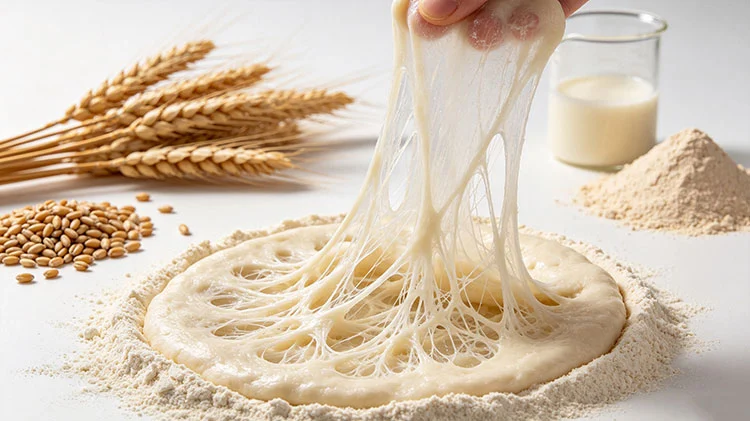
What Is the Difference Between Wheat Protein and Vital Wheat Gluten?
The description, vital wheat gluten, is in general more specific than its close relative, Wheat Protein Powder, when referring to the source of ingredients. The two desirable properties for the use of vital wheat gluten are its ability to retain functional gluten-forming properties after processing and drying.
Functional emphasis: Vital wheat gluten is usually used for its dough development and structural properties.
Protein specification: Commercial grades may have different protein concentrations and other analytical parameters.
Processing behaviour: The hydration, mixing energy, temperature, and formulation composition can affect the development of the gluten network.
Typical applications: Bakery, pasta, noodles, cereal, and selected structured food applications.
Technical selection: Manufacturers need to check the specification sheet of the supplier before making a selection of an ingredient, and not just based on the product name.
Wheat gluten is a complex protein system, and its functionality is due to interactions between various protein fractions and molecular forces, as described in the scientific literature.
How Is Wheat Protein Used in Food Formulation?
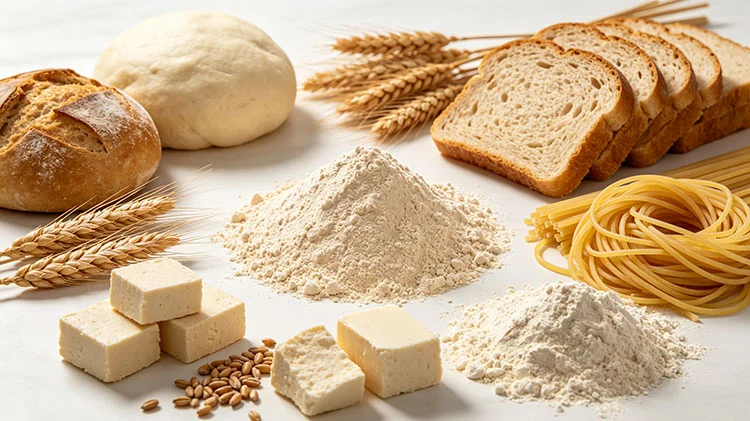
It helps to know what the terminology means, but the key thing for formulators is also to link the ingredient names to the actual processing behaviour. Wheat protein powder can be utilized in various food frameworks as per its grade and working properties.
Bakery products: Wheat protein can be used in cases where gluten-network formation, dough strength, elasticity, and extensibility are desired.
Pasta and noodles: It can affect the cohesiveness of the dough and its processing properties.
Protein-enriched foods: Can provide protein to formulated foods.
Plant-based foods: Wheat gluten may be used in plant-based structured proteins for formulated foods and/or extruded systems.
Dry premixes: If the particle size and density of both the powdered ingredient and the other dry ingredient(s) are compatible, they can be mixed.
The functional characteristics of wheat gluten have been thoroughly investigated for its use in food processing applications, such as rheology, network formation, and as a structural ingredient.
What Should Formulators Consider When Using Wheat Protein?
Wheat Protein Powder cannot be determined by its name alone; what is appropriate. Formulators should consider the ingredient's technical specification, in conjunction with the requirements for the finished product.
Protein grade: Different grades of protein may have different processing characteristics; may need formula modification.
Hydration: Water availability affects the protein system development and system properties.
Protein network formation can be influenced by mixing conditions: shear, mixing time, and sequence of the addition of the ingredients.
Ionic conditions and interactions with starch, enzymes, and other proteins can alter gluten functionality, resulting from salt and other ingredients. Recent studies indicate that the effect of different salts on the rheological properties of preformed gluten networks varies.
Different functional outcomes can be achieved by different processing methods such as baking, extrusion, drying, and thermal or mechanical processes.
How Should Wheat Protein Be Selected for Industrial Applications?
Wheat Protein Powder, wheat gluten, and vital wheat gluten are not terms that can be considered alone; they all depend upon the technical requirements for B2B manufacturers.
Check COA: Check protein, moisture, ash, microbiological specifications, and other agreed quality parameters.
Determine functionality: hydration rate, mixing response, elasticity and extensibility as well as processing behavior (where applicable).
The application does not necessarily dictate the grade to use: A grade usable for bakery dough is not necessarily suitable for an extruded or liquid system.
Think about particle size: Dispersion, hydration, and uniformity of blending can be affected by particle size distribution.
Test process compatibility: Pilot trials should be conducted on the actual production equipment and formula before going to the commercial scale.
Wheat gluten will also undergo a change in functional profile as a result of processing. Research indicates, for instance, that the extent to which gluten joins together, or the viscoelasticity of the gluten, can be reduced by using enzymatic hydrolysis, so processing history is a key specification factor.
You can either call us, email us at info@ scigroundbio.com, or you can just fill in your needs on the form. Our business team is here to react fast and provide a customized solution, competitive deals, and reliable supply to satisfy your business needs.
What is another name for wheat protein?
In the practical use of wheat in the food industry, wheat gluten, vital wheat gluten, and wheat protein may be interchangeable, but are not necessarily the same commercial specifications. Wheat protein is a generic term for wheat protein, and wheat gluten is the specific term for the gluten protein complex found in wheat. The term 'wheat gluten' is also used to refer to a functional dried wheat protein ingredient. The most effective way for manufacturers is to verify the protein content, processing, analysis specifications, and the intended use of the ingredient, and not just the name of the ingredient. This distinction provides the basis for choosing the right grade of Wheat Protein Powder, the right hydration conditions, and mixing, dosage, and processing conditions.
FAQ
Is wheat protein another name for wheat gluten?
The protein fraction of wheat that is rich in gluten is commonly referred to as wheat gluten, and may be more generally referred to as Wheat Protein Powder. The specification should be discussed with the supplier, as this may vary.
What is another name for vital wheat gluten?
Dried wheat gluten or functional wheat gluten is also known as vital wheat gluten. Some of the jargon used in commerce may differ from one supplier to another, and from one market to another.
Is Wheat Protein Powder the same as vital wheat gluten?
Not necessarily. Certain Wheat Protein Powder grades are basically wheat gluten, and others may vary in protein content or be processed differently.
Is wheat gluten used in food manufacturing?
Yes. Wheat gluten is used in many food applications that involve the use of its protein functionality, such as bakery, pasta, noodles, cereal, extrusion, and other uses.
How should manufacturers identify the correct wheat protein ingredient?
Manufacturers need to consider the product specification, COA, protein content, moisture, particle size, allergens, and functional properties, not just the commercial name of an ingredient used.
References
1. Shewry, P. R., & Belton, P. S. (2024). What do we really understand about wheat gluten structure and functionality? Journal of Cereal Science, 117, 103895.
2. Wieser, H., Koehler, P., & Scherf, K. A. (2023). Chemistry of wheat gluten proteins: Qualitative composition. Cereal Chemistry.
3. Zhang, M., Jia, R., Ma, M., Yang, T., Sun, Q., & Li, M. (2023). Versatile wheat gluten: Functional properties and application in the food-related industry. Critical Reviews in Food Science and Nutrition, 63(30), 10444–10460.
4. Shewry, P. R., & Lafiandra, D. (2022). Wheat glutenin polymers 1. Structure, assembly, and properties. Journal of Cereal Science, 106, 103486.
5. Avelar, Z., Pereira, R. N., Vicente, A. A., & Rodrigues, R. M. (2024). Protein quality of cereals: Technological and functional perspectives. Journal of Cereal Science, 117, 103922.
6. Dai, H., & An, H. (2024). Study on the structural characteristics of wheat gluten enzymatic hydrolysates and their effect on the texturization degree of high-moisture plant-protein extrudates. Journal of Cereal Science, 119, 103974.
You may like