Is almond protein powder good for you?
When the protein content, processability, formulation compatibility, and application of Almond Protein Powder are appropriate, it can be a good plant-based protein ingredient. For food manufacturers, it is not so much a “good or bad” judgment and more a quantitative evaluation, based on the protein content, the amount of residual fat, solubility, particle size, flavor, stability, and performance in the finished product.
What Is Almond Protein Powder?
Almond protein powder is made from almond raw materials through the process of milling, partial defatting, almond protein extraction, drying, and controlled the particle size process. Powders can be manufactured using several different routes, each of which gives a different functional property of the powder.
Note: Almond protein powder may contain a different amount of protein content as compared to almond flour or highly purified almond protein isolates. It is important to check the protein assay in the actual formulation before the buyer purchases it.
Residual Fat: Defatting can help adjust protein concentration and can affect the oxidation behavior, mouthfeel, and powder flow.
Particle size: Fine particles will generally disperse more easily, and too fine can lead to dusting or to problems in handling.
The processing history may also affect the protein solubility, protein structure, emulsification, and hydration.
Studies have shown that other factors related to almond processing can greatly affect functionality – such as pH, temperature – and that the technical specification provided by the supplier is crucial to the commercial use of almonds.
Almond Protein Powder Nutrition and Formulation Value
A plant-based protein source for manufacturers looking to offer products that are centered around plant-based and nut-based proteins.
Enrichment in protein: The main use of its formulation is to provide protein to the finished product based on the percentage of protein in the powder.
Plant-based positioning: Other uses of almond protein powder can be in dairy-free and plant-based applications where almond proteins can be accepted.
Sensory contribution: It has a nutty flavor, which can add to chocolate, vanilla, cereal, fruit, and dessert flavors.
A combination of almond protein powder with other protein sources (pea, rice, oat, or other vegetables) can be used to achieve a blending of the sensory and functional properties of the protein systems.
It is important to always use the actual ingredient specification and not assume the nutrient contribution from the general composition of ingredients because they are processed differently and vary in concentration among commercial almond protein powders.
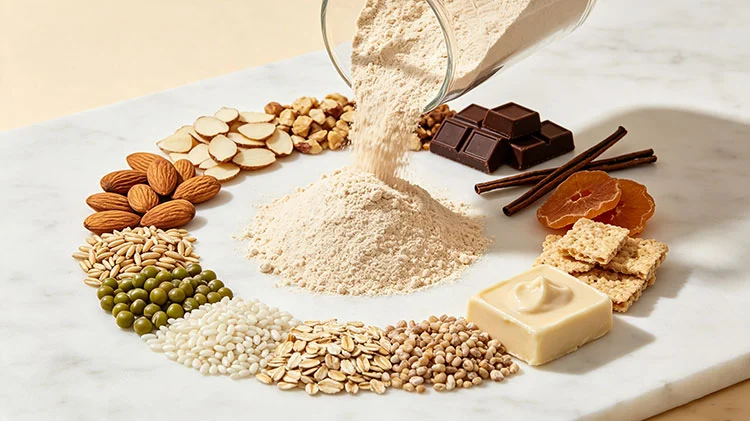
How to Use Almond Protein Powder in Formulations
There is no standard almond protein powder dose as it varies depending on the protein needed, matrix, and desired texture.
Protein beverages: Mix powdered protein with other dry ingredients prior to mixing with water to prevent clumping.
Protein shakes: Assess the performance of a product in the product at the desired concentration, not in the lab by using water samples.
Protein bars: Almond protein powder can provide protein and solids, while syrups, fats, fibers, and water levels will have to be fine-tuned to ensure that the product is not too hard or chewy.
Add to bakery formulas (Cookies, Muffins, Snack Products, Dry Baking Mixes): Most formulas can be used, and hydration and structural ingredients adjusted during pilot trials.
In the case of powdered nutrition mixes, particle-size compatibility with other ingredients needs to be determined to minimise segregation when filling and transporting the ingredients.
Formulators should decide the dosage to be used in commercial development by conducting bench testing and pilot production. The sensory performance and dispersibility, as well as the final viscosity, cannot be predicted from the percentage of protein in the sample.
Almond Protein Powder Stability and Storage
When buying almond protein powder in bulk and storing it prior to use, it is essential that it is stable.
Moisture: Caking, inadequate flow, and changes in dispersion can all be caused by humidity.
Exposure to oxygen: Powders with leftover almond fats and oils have to be properly protected from oxygen during storage.
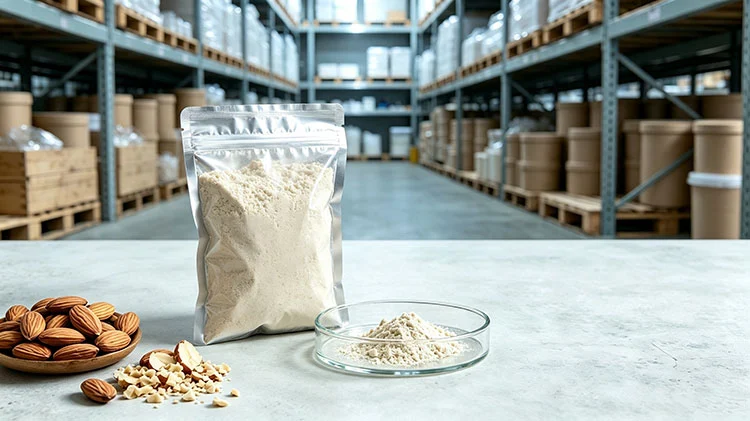
Packaging: Moisture- and oxygen-barrier packaging can aid in maintaining the quality of the ingredients during transportation and in warehouse storage.
Temperature: Cool and dry, in the absence of too much light and heat, is generally best.
Quality monitoring: Commercial specifications should be for parameters relevant to the application, including protein, moisture, fat, microbiological quality, and sensory characteristics.
Finally, the stability after incorporation of powder into the product should be considered by the formulator, as other components of the product such as pH, salts, heat treatment, etc. can alter the interactions between the proteins.
Almond Protein Powder pH, Solubility, and Processing
The processing conditions can have a significant effect on the functionality of proteins. Studies on the proteins of almonds have revealed that the pH and temperature influence the structure, solubility, foaming, and gel formation capacities of the proteins.
Note that pH levels may be different for an acidic formula, so it is important to test the actual desired pH when developing a beverage formula.
Heat: Final protein texture and interactions can be modified by pasteurization or other heat processing.
Ionic environment: Minerals and salts can have an impact on the aggregation and dispersion of proteins.
Hydration time: The extra time a product is given to be hydrated can improve homogeneity before going further or before homogenization.
Homogenization: High shear processing can be used to enhance physical uniformity but needs to be assured for the particular powder specification.
The variables are the reason for needing further optimization of a formulation when going to commercial processing.
Industrial Applications of Almond Protein Powder
Almond protein powder can be explored for potential applications in a variety of food and food ingredient categories, where the sensory attributes and properties of the product correspond with the concept of the product.
Blend of plant proteins: As part of multi-source protein systems.
Protein beverages: Can be used for powdered drink mixes or ready-to-mix formulations that have been dispersed and tested for stability.
Protein bars and snacks: Can be beneficial in products where the protein is an acceptable source of flavor.
For cookies, muffins, crackers, and baking mixes, ready to use for bakery products to provide protein.
Dairy-alternative foods: May be assessed in specific plant-based products that are properly labelled and controlled for allergens.
Almonds are considered a tree nut and are among the "major food allergens" that are defined by U.S. federal food law requirements for food labelling. Manufacturers should set up appropriate cross-contact controls, segregation, sanitation, supplier documentation, and ingredient declaration controls.
Do it yourself by email at info@scigroundbio.com or just fill in the form given below. We are able to provide a dependable supply, competitive prices, and customized products to fit your needs.
Is Almond Protein Powder Good for You?
In conclusion, almond protein powder can be a valuable plant-based protein for use in certain applications, depending on its specific application and the desired properties. Its value is due to its protein contribution coupled with its sensory properties (derived from almonds), its formulation potential, and compatibility with various food systems. But manufacturers should not base their decision only on the percentage of protein in almond protein powder. Before scale-up, it is important to consider the following factors regarding the protein: protein assay, residual fat, particle size, pH behavior, solubility, storage stability, processing tolerance, allergen status, and finished-product performance. Documentation and application testing continue to be critical for buyers for reliable commercial performance.
FAQ
Is almond protein powder a good plant-based protein ingredient?
Almond protein powder can serve as an ingredient in drinks, bakery items, snack bars, and mixed protein powders. It is suitable depending on the protein concentration, protein functionality, sensory properties, and technical requirements of the final product.
What is the best almond protein powder dosage for food formulations?
The amount of almond protein powder needed varies from person to person. The manufacturers must calculate the percent inclusion based on the protein assay from the supplier and the desired protein level in the finished product; then optimize the formulation with various levels of water, viscosity, flavours and texture.
Can almond protein powder be used in protein shakes?
Yes. Almond protein powder can be added to protein drinks or powdered drink mixes. The ability to disperse, sediment, viscosity, mouthfeel, and stability should be considered by the developer under actual processing and storage conditions.
Is almond protein powder suitable for bakery applications?
Yes. Cookies, muffins, snack bars, crackers, and baking mixes are just a few uses for almond protein powder. The flour, liquid, fat, and binder system may require modification due to the change in the protein, solids, and water balance.
How should bulk almond protein powder be stored?
Bulk almond protein powder is best kept in sealed containers in a cool, dry place and away from direct light, humidity, oxygen, and high temperatures. The direction of the supplier's storage specification is required to be followed.
Does almond protein powder require allergen labeling?
Almonds are a tree nut, a major food allergen for U.S. food products. When considering commercialization, manufacturers of products containing almond allergen protein powder should check applicable allergen declaration and cross-contact requirements.
References
1. Rachwał, D., et al. (2021). Structure and functionality of almond proteins as a function of pH. Food Structure, 30, 100229.
2. [Authors as indexed]. (2022). Effects of enzymatic extraction on the simultaneous extraction of oil and protein from full-fat almond flour, insoluble microstructure, emulsion stability and functionality. Future Foods, 5, 100151.
3. Dias, F. F. G., Huang, Y.-P., Schauer, J., Barile, D., Van de Water, J., & Moura Bell, J. M. L. N. (2023). Effects of protease-assisted aqueous extraction on almond protein profile, digestibility, and antigenicity. Current Research in Food Science, 6, 100488.
4. Xiao, X., Zou, P.-R., Hu, F., Zhu, W., & Wei, Z.-J. (2023). Updates on plant-based protein products as an alternative to animal protein: Technology, properties, and their health benefits. Molecules, 28(10), 4016.
5. Chen, W., et al. (2023). Plant-based proteins: Advanced extraction technologies, interactions, physicochemical and functional properties, food and related applications, and health benefits. Critical Reviews in Food Science and Nutrition, 64, 667–694.
6. U.S. Food and Drug Administration. (2025). Guidance for Industry: Questions and Answers Regarding Food Allergen Labeling (Edition 5). U.S. Department of Health and Human Services.
You may like