Is almond protein better than whey protein?
Almond Protein isn't necessarily superior to whey protein; whey tends to have a more robust protein quality profile, while almond protein may be better suited for nut-, plant-based, and dairy-free formulations.
Almond Protein vs Whey Protein: Core Differences
Almond protein and whey protein are different in terms of the source, composition, process used in their manufacture, and the purpose they are used for.
The sources of the proteins are the almond kernel for almond protein and milk for whey protein.
Essential amino-acid profile: Whey has a good profile, and almond protein has a different profile.
Almond protein can be processed by defatting, extraction, concentration, and drying, whereas whey is usually available in the form of whey concentrate or isolate.
Positioning: Almond protein powder will be of interest to plant-based and dairy-free products.
Almond Protein vs Whey Protein: Protein Quality
The quality of protein is important, but manufacturers are required to differentiate characteristics from a nutritional and technical point of view.
Essential amino-acid profile: Almond protein has a different profile to whey, which in general is favourable.
Digestibility: This varies with type and source of protein, processing, and finished food matrix.
Commercial almond protein powders have different protein assays, and specification comparisons should be done to the analytical specification.
Almond protein can be used in combination with pea, rice, oat, or other plant proteins to alter the properties of the protein blend.
Nitrogen balance was achieved with both almond and whey protein beverages in the same controlled study conducted in 2021, which didn't conclude that the nutritional profiles of the two would be the same.
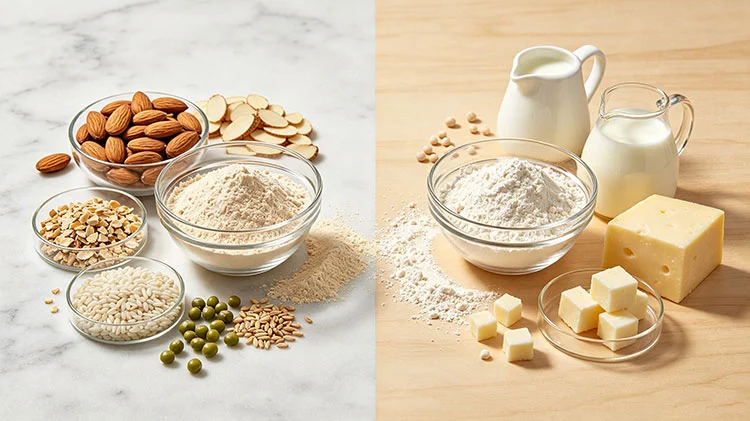
Almond Protein Powder vs Whey Protein Powder in Formulation
For manufacturers, attributes like functionality are of equal importance as protein composition.
Solubility: Whey protein powder tends to disperse easily in a wide range of beverage systems, and almond protein powder may need to be hydrated to maximize its solubility.
Almond protein functionality is pH-dependent and may also be affected by ionic conditions, such as dispersion and stability.
Heat: Thermal processing can cause alteration of the structure of the protein and the finished product's texture.
Viscosity: Protein loading, particle size, hydration, and other solids all have an effect on the viscosity.
Emulsification: Almond protein can be useful in certain food systems when it comes to providing functional properties such as interfacial properties.
Thus, sticking to the substitution ratio of replacing 1g of whey protein powder with 1g of almond protein powder is not a good idea.
Almond Protein and Whey Protein Dosage and Stability
The dosage, together with the stability, should be assessed during the commercial formulation.
Dosage: Determine the amount of inclusion based on the protein assay done by the supplier and the desired protein concentration of the finished product.
Hydration: The amount and manner of watering of almond protein and whey can vary.
Moisture: Humidity can cause caking and can decrease the flow of powder.
Oxidation: The protein from almonds also has some lipids which need to be controlled in terms of oxygen, heat, and light.
Packaging: Barrier packaging can be used to safeguard the storage and transportation of powders.
Validation requires bench trials, pilot-scale trials, and shelf life testing.
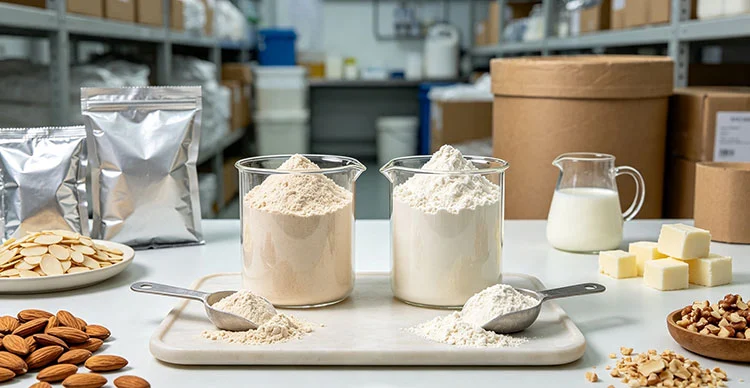
Almond Protein vs Whey Protein for Beverage and Food Applications
Depending on the product matrix and the commercial positioning, the right component is used.
Protein drinks: Whey could be chosen because it is established to be soluble; almond protein can be used for plant-based concepts.
Acidic drinks: Both need to be tested to see if they aggregate, disperse, and remain stable under the target pH.
Snacks and bars: Almond protein can be used in combination with flavor systems that are derived from nuts, chocolate, cereal, or plants.
Hydration and structural effects are different for both proteins in bakery products, where they can be used in formulas enriched in protein.
Protein blends: Almond protein may be used in combination with complementary plant proteins, as a more comprehensive approach to formulation.
Do it yourself by email at info@scigroundbio.com or just fill in the form given below. We are able to provide a dependable supply, competitive prices, customized product to fit your needs.
Is Almond Protein Better Than Whey Protein?
Almond protein has not been proven to be better than whey protein; the specific type to be used would depend on the product objective. While the protein quality and beverage functionality of whey are generally superior, the plant-based, dairy-free, and recognizable nutty protein of almond protein is more appropriate if a manufacturer requires such a protein. When comparing for procurement, protein assay, amino acid profile, solubility, particle size, residual fat, moisture, processing tolerance, storage stability, allergen status, and finished product performance should all be taken into account. The best judgment is thus made by evaluating the entire specification and experience gained by running the application rather than just saying “better”.
FAQ
Is almond protein better than whey protein for plant-based products?
Usually, almond protein will not be used to make dairy products since almonds do not produce milk. Protein concentration, protein functionality, flavour, and formulation requirements still remain important parameters to take into consideration for its suitability.
Is almond protein as good as whey protein?
Almond protein is different in terms of nutrition and functional properties from whey protein. Whey typically has a much better protein profile established, and almond protein is used for a plant-based formulation or concept using almond products.
Can almond protein powder replace whey protein powder?
In some products, almond protein powder can be used to replace whey, but it should not be used as a direct replacement in all products. The protein concentration and hydration, as well as protein viscosity, flavour, and solubility, may need to be reformulated.
Is almond protein suitable for protein shakes?
Yes. Almond protein powder can be used to make dairy-free protein shakes and power drinks. The dispersion, sedimentation, mouthfeel, flavor, and stability of these should be evaluated by the manufacturer at the intended inclusion level.
Can almond protein and whey protein be blended?
However, they can technically be used together if it is the product concept allows both dairy and almond to be used together. The final formula should be tested for allergen labeling, sensorial, stability, and protein interactions.
What should manufacturers compare when sourcing almond protein and whey protein?
When purchasing a protein, it is important to look at other factors in addition to the protein percentage, such as amino acid profile, solubility, particle size, moisture, residual fat, microbiological specifications, shelf life, packaging, allergen documentation, and application data.
References
1. Shi, T., Cao, J., Cao, J., Zhu, F., Cao, F., & Su, E. (2023). Almond (Amygdalus communis L.) kernel protein: A review on the extraction, functional properties and nutritional value. Food Research International, 167, 112721. ScienceDirect
2. Lima, R. R., Stephani, R., Perrone, Í. T., & de Carvalho, A. F. (2023). Plant-based proteins: A review of factors modifying the protein structure and affecting emulsifying properties. Food Chemistry Advances, 3, 100397. ScienceDirect
3. Xiao, X., Zou, P.-R., Hu, F., Zhu, W., & Wei, Z.-J. (2023). Updates on plant-based protein products as an alternative to animal protein: Technology, properties, and their health benefits. Molecules, 28(10), 4016. MDPI
4. Maykish, A., Nishisaka, M. M., Talbott, C. K., Reaves, S. K., Kristo, A. S., & Sikalidis, A. K. (2021). Comparison of whey versus almond protein powder on nitrogen balance in female college students: The California Almond Protein Powder Project (CAlmond-P³). International Journal of Environmental Research and Public Health, 18(22), 11939. PubMed
5. Rashwan, A. K., Osmand, A. I., Abdelshafye, A. M., Mo, J., & Chen, W. (2024). Plant-based proteins: Advanced extraction technologies, interactions, physicochemical and functional properties, food and related applications, and health benefits. Critical Reviews in Food Science and Nutrition, 64, 667–694. Taylor & Francis
6. U.S. Food and Drug Administration. (2025). Guidance for Industry: Questions and Answers Regarding Food Allergen Labeling (Edition 5). U.S. Department of Health and Human Services. FDA
You may like