Who cannot take vitamin B1?
Vitamin B1 (Thiamine HCL) is not recommended in certain regulated formulations, specific product designs, and carefully controlled labeling situations where it does not fit in with the requirements of ingredient compatibility and/or compliance or finished product.
Vitamin B1 (Thiamine HCL) Regulatory and Labeling Constraints
Thiamine Hydrochloride is not always used in industrial formulations and compliance systems; however, depending on the product positioning and regulatory requirements, it may be limited in use.
Restricted-label product categories
For certain specialised formulations where there are strict compositional requirements, further micronutrient additions might be restricted, and some vitamins may need to be excluded for ease of labelling or for regulatory reasons.
Region-specific compliance differences
The nutrient declaration rules may differ from market to market, and this may affect the inclusion of Vitamin B1 or the adaptation of its use in the design of the Vitamin premix.
The nutrient fortification systems are overlapping.
It may be necessary to use only a small amount of thiamine because products may already have a high level of vitamin B6, B12, and/or folic acid.
Formulation Incompatibilities in Vitamin B1 (Thiamine HCL) Systems
When considering the manufacture of the product, the possible biological limitations of Vitamin B1 may not be the main limiting factor, because of its technical formulation characteristics.
pH-sensitive processing environments
Thiamine HCL can be less stable at extreme pH levels, and this could be a design factor in acidic or highly alkaline systems.
Oxidation-sensitive multi-ingredient blends
For complex antioxidant or botanical systems, there could be interactions with other reactive compounds that may necessitate a protective capsule or modified processing procedures.
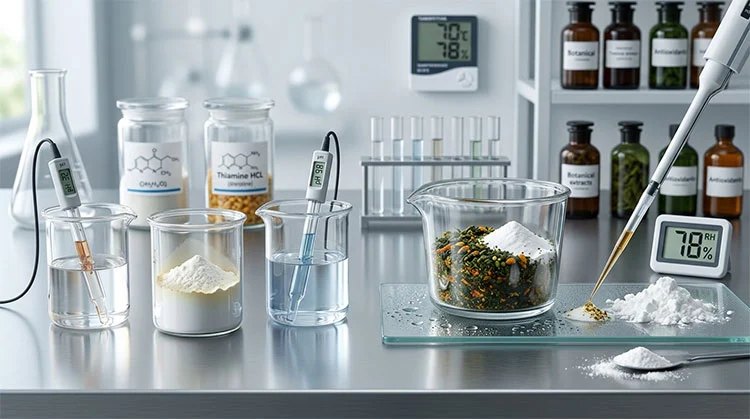
Moisture-sensitive production lines
The high humidity in powder blending can have a negative influence on the flowability and stability properties and thus restrict direct use without anti-caking or stabilization systems.
Dosage Design Limitations in Vitamin B1 (Thiamine HCL) Products
In B2B product development, one oftentimes limitation is found to be related not so much to end user restriction, but rather the formulation architecture.
High-density micronutrient systems
If more than one vitamin and/or mineral is being formulated together, the thiamine level may be limited by formulation space.
Single-dose packaging constraints
The ingredients of stick packs, gummies, or chewable products are tightly balanced, making it less flexible to add more Vitamin B1.
The flavours and sensory optimisation requirements
The use of taste masking or sensory control can lead to the inclusion or reduction of Vitamin B1 in the beverage and flavored products.
Quality Control and Raw Material Selection Factors for Vitamin B1
At the same time, the application of Thiamine Hydrochloride in the production process relies on the standard of raw materials and the uniformity of raw material sources.
Assay variability considerations
Often, lower-grade raw materials will not be of a high enough assay for use in high-precision formulations.
The maximum permissible levels of heavy metals and impurities.
Batches that contain levels of impurities above the internal requirements for the product may be rejected when products have ultra-clean specifications (e.g., premium nutrition systems).
Insufficient documentation and documentation skills, lack of certification.
Some batches may be ruled out of the process for export production due to a lack of GMP, ISO, or Kosher/Halal certification.
Application-Specific Restrictions in Vitamin B1 (Thiamine HCL) Product Development
Specific constraints are encountered when designing formulations for different product categories, for Vitamin B1.
Formulations that are extremely minimalist and referred to as “free-from.”
There are some clean label systems that focus on the most simplified ingredient lists and restrict the use of micronutrient blends.
Specialized sensory-driven products
It is possible that, when providing Vitamin B1 for a beverage or confectionery system, the requirements for color, solubility, or taste optimization purposes may limit the Vitamin B1 supply.
New and creative capsule packaging solutions
Special forms of vitamins may be needed for advanced controlled release systems instead of Thiamine HCL powder.
Who cannot take vitamin B1?
The use of Vitamin B1 (Thiamine HCL) is not always prohibited in industrial nutrition and ingredient production, but it depends on regulatory requirements, formulation stability, dosing architecture, and technical requirements for the product. Most restrictions are not the ingredients per se, but the ingredient combinations, labeling, and production. For manufacturers, it is important to be able to understand these boundaries, which are crucial for designing products in the optimal way, ensuring product compliance, and maintaining product performance in various application categories.
You can simply write us an email to info@scigroundbio.com regarding the same, or you can fill in the requirement form at the bottom, and our staff will get back to you with immediate assistance, product details, and competitive quotes, which will help you in making your purchases.
FAQ
Q1: Who cannot use Vitamin B1 (Thiamine HCL) in supplement manufacturing?
Typically, restrictions will be based on formulation design rules, regulatory labeling requirements, and compositional limits for a particular product in manufacturing environments.
Q2: Can Vitamin B1 be used in all beverage formulations?
Not always. Its inclusion will be dependent on its ability to maintain stability at the desired pH, the design of the flavor system, and interaction with other functional ingredients in the beverage matrix.
Q3: Why is Vitamin B1 sometimes excluded from multi-vitamin premixes?
When nutrient levels are standardized, some premixes do not duplicate nutrients, include excessive nutrients, or deal with regulatory issues.
Q4: What affects the compatibility of Vitamin B1 in food systems?
These include sensitivity to moisture, sensitivity to oxidation, processing temperature, and interaction with other active compounds.
References
1. National Institutes of Health (NIH). (2024). Thiamin Fact Sheet for Health Professionals. Office of Dietary Supplements.
2. EFSA Panel on Nutrition, Novel Foods and Food Allergens. (2022). Dietary reference values for thiamine. European Food Safety Authority Journal.
3. Whitfield, K. C., et al. (2021). Thiamine deficiency disorders: diagnosis, prevalence, and a roadmap for global control. Nutrients, 13(5), 1595.
4. Lonsdale, D. (2020). Thiamine metabolism and its role in human health: updated review. Advances in Nutrition, 11(4), 821–832.
You may like