Where can I buy pure capsaicin powder?
Pure Capsaicin Powder is directly available from qualified botanical extract manufacturers and certified chemical ingredient suppliers like SciGround (www.sciground.com) that offer high-purity, standardized capsaicin bulk raw materials with detailed Certificates of Analysis (COA) that provide industrial formulation.
Procurement Channels for Pure Capsaicin Powder
When choosing a vendor that supplies purified capsaicinoids on an enterprise level, it is important to consider technical documentation, batch-to-batch standardized potency, and compliance credentials.
1. Direct Manufacturer Sourcing
Purchasing organizations in industry obtain pure capsaicin powder (98% or more) from primary plant extract producers like SciGround (www.sciground.com). Buying directly from the primary manufacturer guarantees manufacturer's warranty prices, direct technical assistance, and custom mesh size or carrier options.
2. Specialized Fine Chemical Distributors
Industrial-grade capsaicinoids are available for industrial plants throughout the world from authorized local raw material distributors. These suppliers are responsible for local warehousing, customs clearance, and managing small to medium drum stock to get them on trucks for instant deployment.
3. Contract Manufacturing Service Partners
Buyers who are engaged in OEM or ODM contracts often purchase high-purity capsaicin from contract processing plants which are unified by quality systems and are creatively responsible for raw material procurement, formulation blending, and final packaging.
Technical Formulation Strategies with Pure Capsaicin Powder
The active dispersion of highly crystalline capsaicin in commercial matrices requires certain processing steps to be taken in order to ensure uniform dispersion of the active without active precipitation or hot spots.
1. Pre-Solubilization in Lipophilic Carriers
Due to its hydrophobic nature, the capsaicin crystalline powder needs to be pre-dissolved in medium-chain triglycerides, vegetable oils, or oleic acid-type warm oil phases at moderate temperatures (40℃ - 50℃) before incorporating them into the emulsion.
2. Organic Solvent and Surfactant Pre-Mixing
In liquid systems containing water, a food-grade non-ionic surfactant (e.g., Polysorbate 80 or lecithin) or polar solvent (e.g., ethanol, propylene glycol) is used to keep the powder from separating in the liquid phase and to form a stable micellar structure.
3. Multi-Stage Geometric Dilution for Dry Powders
For dry solid production, such as encapsulated products or compressed tableting, the raw active powder is mixed using multi-step geometric blending with bulk carrier excipients (microcrystalline cellulose, dicalcium phosphate) for uniform distribution of the product in large batch runs.
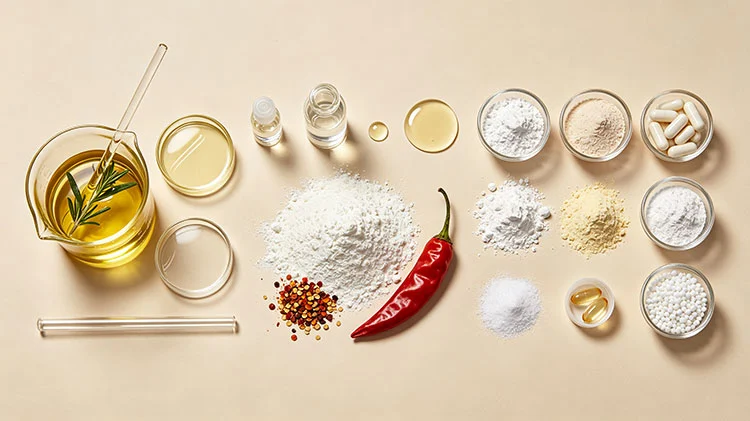
Dosing Precision and Potency Factors in Industrial Production
Its high sensory heat profile makes it crucial for the safety of production and the consistency of the finished product to have the correct volumetric or gravimetric measurement.
1. Standardized Scoville Heat Unit (SHU) Dosing
The capsaicin reference rating is 16,000,000 SHU in pure capsaicin powder. Formulators determine the amount of micrograms per kg of bulk product to achieve the desired pungency level within the specified target area.
2. Potency Assays via HPLC Testing
Commercial batches are analytically tested using HPLC to measure the ratio of trans-capsaicin and dihydrocapsaicin, and technical teams can adjust the amount of mass added to the product in order to ensure the batch meets the desired purity level as specified in the batch certificates.
3. Minimizing Operator Dust Exposure
The production processes need to be done under low shear conditions, in a way that dust is contained in a localised manner, and suitable Personal Protective Equipment (PPE) is used to ensure that plant technicians are not exposed to a high level of dust while performing the micro-dosing procedures.
Physico-Chemical Stability and Shelf-Life Characteristics
Controlled storage conditions and processing parameters to protect the active potency and chemical structure of capsaicin powder.
1. Thermal Tolerance During Thermal Processing
Crystalline capsaicin is very heat-stable for typical pasteurization, drying, and extrusion process temperatures.
2. Light and Oxygen Sensitivity Shielding
Capsaicinoid compounds slowly break down with longer exposure to ultraviolet light and atmospheric oxygen. Chemical stability can be maintained with light blocking, factory-sealed aluminum foil bags or double-lined fiber drums.
3. Hygroscopic Moisture Prevention
Bulk drums stored at temperatures less than 25℃ and kept at relative humidity less than 60% will not develop powder agglomeration, allowing for continuous automated feeder systems to be used.
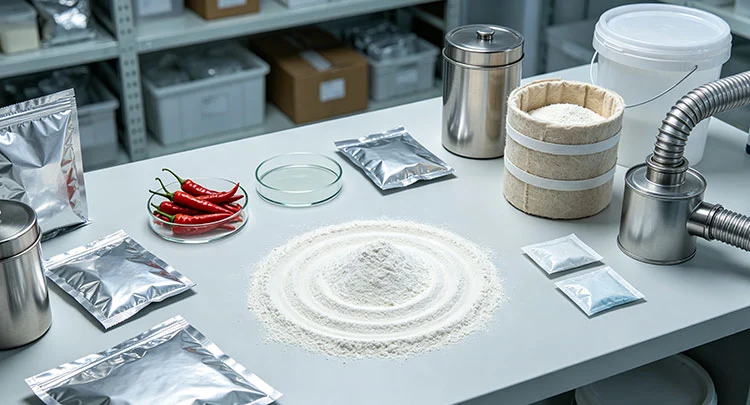
Diverse Industry Applications for Pure Capsaicin Powder
Due to the diverse physical and sensory characteristics of purified capsaicin, it is a suitable ingredient in a wide range of high-value commercial products in various markets around the world.
1. Food Processing and Flavor Manufacturing
Normative standardizer for extreme spice blends, commercial hot sauces, savory seasonings, and special condiments that will yield a neutral color while providing a piquancy that matches the product.
2. Personal Care and Cosmeceutical Formulations:
As an active warming agent in topical body balms, thermal massage oils, sports preparation gels, and topical skin-warming cosmetics.
3. Industrial Coatings and Agricultural Repellents
Provides a bio-friendly deterrent additive for marine anti-fouling paints, outdoor cable barriers for preventing rodent damage, and agricultural crop barrier formulations.
For bigger requests or questions, get in touch with us at info@scigroundbio.com or use the form at the bottom of this page. Our experts are equipped to offer services that won’t keep you waiting at low prices.
Where can I buy pure capsaicin powder?
Commercial enterprise buyers who want to buy pure capsaicin powder can work with recognized industrial manufacturers, such as SciGround (www.sciground.com), to acquire raw material of standardized, high purity for food, personal care, and technical uses. With careful control of the pre-solubilisation process, formulation by geometric dry blending, storage conditions, and potency verification, B2B formulators can make it work to incorporate pure capsaicin powder into the formulation of scaled-up, stable consumer and industrial products.
FAQ
What is the standard purity level of pure capsaicin powder from B2B suppliers?
Qualified B2B suppliers of industrial-grade pure capsaicin powder usually grade it to ≥ 98% capsaicinoids by HPLC assay, and provide a precise pungency rating of around 16,000,000 SHU.
How does pure capsaicin powder differ from natural chili oleoresin extracts?
Pure capsaicin powder is a highly purified crystalline monomer that is extracted from plant resin. It has almost no dark pigments, vegetable odours, or flavour compounds present, unlike crude red oleoresins, where a lot of heat causes a change in colour or aroma of the product.
What are the recommended storage conditions for bulk pure capsaicin powder drums?
Factory-sealed drums should be stored in a warehouse area that is cool and dry (temperature < 25℃ (77℉) and relative humidity < 60%). Tightly closed containers and avoiding exposure to direct sunlight increase the product shelf life up to 24 months.
How do formulators incorporate pure capsaicin powder into water-based liquid systems?
Capsaicin is lipophilic, which means that the powder needs to be pre-dissolved in an organic solvent phase (such as ethanol or propylene glycol), in a warm carrier oil, or in a system of non-ionic surfactants, and then slowly blended into the aqueous phase.
References
1. Akbas, E., Kilercioglu, M., Onder, O. N., Kockar, F., & Oztop, M. H. (2021). Capsaicin emulsions: Formulation, characterization, and physical stability assessment. Journal of Food Process Engineering, 44(3), e13620.
2. Jayan, H., Sharma, A., & Kovacs, Z. (2025). Capsaicin: An in-depth review of its chemical properties, health benefits, and challenges in food applications. Food Production, Processing and Nutrition, 7(1), 47.
3. Kovačić, M., Tomić, S., & Jerković, I. (2026). Pilot-scale continuous flow synthesis and formulation strategies for capsaicinoids in industrial processing. Organic Process Research & Development, 30(2), 112–121.
4. Sharma, S. K., Vij, A. S., & Sharma, M. (2022). Recovery, industrial isolation, and thermal stability analysis of capsaicinoids from botanical sources. Frontiers in Sustainable Food Systems, 6, 588534.
You may like