What is the best source of chlorogenic acid?
Green Coffee Beans are one of the best sources of Chlorogenic Acid, as they contain high quantities of chlorogenic acids, which are caffeoylquinic acids, and are used to make standardized botanical extracts. The final source will depend on the concentration, quality of extract needed, compatibility of formulation, and application.
Chlorogenic Acid (CGA) is a naturally occurring polyphenolic compound that is present in the coffee bean, tea, fruits, vegetables, and other botanical materials. For commercial manufacturers, source selection includes considering the botanical composition, the efficiency of extraction, analytical specifications, stability, and batch consistency.
Green Coffee Beans: A Primary Source of Chlorogenic Acid
Coffea arabica and Coffea canephora are two popular species for green coffee beans used to make chlorogenic acid extracts.
Natural concentration: Unroasted beans are also rich in various chlorogenic acids, which vary according to cultivar, growing conditions, and processing.
Important constituents of the chemical profile: 5-O-caffeoylquinic acid (5-CQA). Must be separated from the total chlorogenic acids.
For standardised botanical ingredients, established supply chains for sourcing.
Roasting may cause changes in the chlorogenic acid composition in the product due to chemical changes under heat. If the need to preserve these compounds is important, unroasted beans are likely the better option.
Green coffee bean extract provides a convenient and economical source of chlorogenic acid for the bulk market.
Alternative Botanical Sources of Chlorogenic Acid
Sources of chlorogenic acid or other caffeoylquinic acid-containing materials may also be other botanical materials.
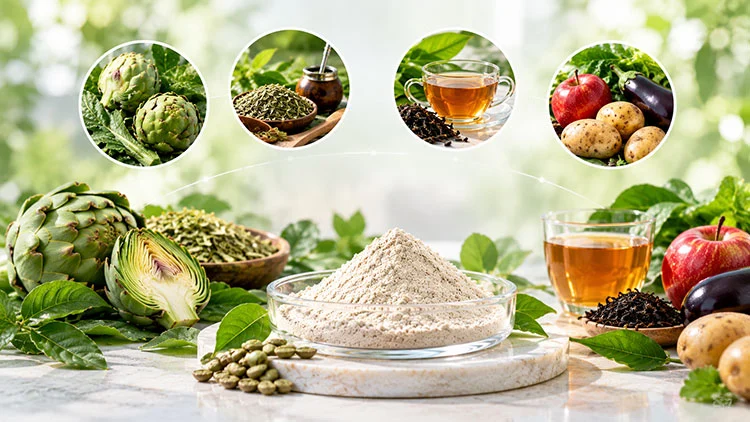
Artichoke leaves: Have several caffeoylquinic acid derivatives and have a wider botanical profile.
Yerba mate: Offers naturally occurring plant chemicals along with chlorogenic acids.
Theaflavins: Polyphenols present in tea leaves, but their composition is different from that of green coffee extracts.
Fruits and vegetables: Apples, eggplant, and potato contain varying amounts, depending on how much is extracted and the processing yield.
Compare using the same unit of measure. Concentrations based on fresh weight, dry weight percentages, and concentrated-extract assays cannot be directly converted. Results are also influenced by the moisture content and by the method used for analysis.
Selecting a Chlorogenic Acid Extract Specification
The chlorogenic acid extract should meet certain analytical and quality requirements.
Assay: Indicate % required and state if it is the 5-CQA or total chlorogenic acids.
The test method used is compound-specific quantification, usually by high-performance liquid chromatography (HPLC).
Quality documentation: Ask for a Certificate of Analysis (COA), botanical information, batch info, and contaminant test results.
Extraction details: Discuss the solvent, extract ratio, ingredients of the carrier, and the process of standardization.
The higher the extract ratio, the higher the purity of the chlorogenic acid. A compound-specific assay cannot be replaced by the total polyphenol content.
Formulation Tips for Chlorogenic Acid Ingredients
The properties of the ingredients and the final matrix of the formulation have a strong influence on formulation performance.
Particle size, bulk density, moisture, and blend uniformity of powder blends. A suitable carrier can increase the distribution of the product at low inclusion levels.
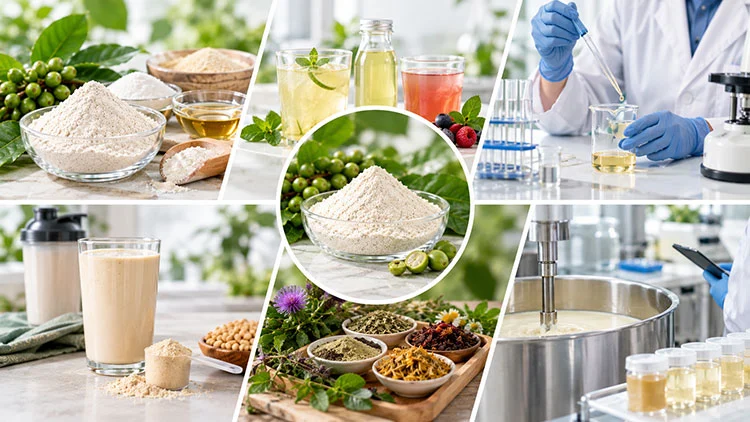
Beverages: Test dissolution, turbidity, sedimentation, color, and flavor in the real beverage system.
Precipitation and dispersion of proteins and/or polyphenols, as well as their analytical recovery, may be influenced by polyphenol-protein interactions in the preparation of protein products.
Botanical blends: Minerals and other plant extracts have the potential to impact appearance, sensory properties, and measurable chlorogenic acid levels.
Record mixing order, temperature, pH, and processing time before commercial production. Small-scale trials are useful to detect any compatibility problems before scale-up.
Chlorogenic Acid Dosage and Inclusion Calculations
The proper amount of chlorogenic acid to include will vary depending on the specification, the amount of chlorogenic acid in the ingredients, product category, and applicable regulations.
Specify the desired amount of chlorogenic acid per serving/batch.
Determine the strength of the assays: Extracts of varying concentrations contain varying amounts of the compound being tested.
Determine the mass of ingredients: Target chlorogenic acid mass/assay fraction.
Accept losses: Analyze losses with stability data and decide if adjustments to processing are needed.
The following example is given: with 100 mg of chlorogenic acid, which equals 50 mg of an extract, 200 mg of an extract, which corresponds to 50 mg of the assay (assumed to be the target compound), is required, taking into account the fact that there are no processing losses. This is an example of a calculation and is not a recommended intake level.
Chlorogenic Acid Stability and Storage
The stability of chlorogenic acid can be affected by factors such as temperature, pH, light, oxygen, moisture, and interactions with ingredients.
Temperature: Assess exposure during drying, pasteurization, etc., and other thermal processes.
pH: Conduct actual formulation tests within the pH range.
Light and oxygen: Use appropriate packaging and storage methods to reduce/prevent unwanted changes.
Moisture: The moisture barrier packaging can also minimize powder caking and deterioration.
Shelf life: Conduct appropriate moisture, appearance, and chlorogenic acid assay testing at predetermined time intervals.
Test both extracted and processed product due to processing and matrix interactions that may result in changes in stability.
Industrial Applications of Chlorogenic Acid Extracts
The extracts of Chlorogenic acid can be checked for several commercial applications depending on the grade of ingredients and their suitability for regulations.
Protein powders: If you're looking for a powdered protein supplement.
Functional beverages: For the solubility, color, and flavor of formulations to be evaluated.
Food development: Selected food systems that have been found to be compatible based on ingredients.
Cosmetics: For appropriate cosmetic formulations, which are compliant with the quality and regulatory standards.
Formulation development: Comparative formulation and analytical studies of ingredients.
Not all chlorogenic acid extract is suitable for all applications. Before commercial production, manufacturers should check their specifications and requirements for use.
What is the best source of chlorogenic acid?
One of the most useful sources of chlorogenic acid for preparing commercial standardized extracts is green coffee beans. Other botanicals such as artichoke leaves, yerba mate, tea, and others are alternatives for various formulation needs. The most suitable will depend on the requirements of the assay in terms of accuracy, extraction efficiency, batch consistency, stability, and regulatory suitability. The botanical origin and concentration advertised for a product are more important for B2B buyers than a verified specification and reliable analytical documentation.
To ask questions, order in large quantities, or request tailor-made specifications, you can call us at info@scigroundbio.com, or you can just fill out your specifications on the requirement form at the bottom of the page, and our team will reply with information on the product and a quote in time.
FAQ
1. What is the richest natural source of chlorogenic acid?
The most popular source is green coffee beans. Actual concentrations will depend on the species, cultivar, growing conditions, and processing.
2. Is green coffee bean extract better than artichoke extract?
Green coffee extract can be used in various standard applications of chlorogenic acid, and artichoke extract has a different botanical profile. Selection is based on composition, assay, and use.
3. How is chlorogenic acid measured in bulk extracts?
HPLC is a widely used technique for quantifying chlorogenic acid. It is important for the buyer to confirm that the compound targeted, the reference compound, and the analytical method are correct.
4. What affects chlorogenic acid stability?
Stability can be affected by temperature, pH, light, oxygen, water, and other ingredients.
5. How do manufacturers calculate chlorogenic acid inclusion levels?
Divide the compound to be divided by the assay fraction of the ingredient, and use an appropriate test to validate the formulation.
6. What should buyers check before purchasing bulk chlorogenic acid powder?
Read the assay, botanical source, extraction information, COA, contaminant testing, packaging, shelf life, and destination-market information.
References
1. Wang, L., Pan, X., Jiang, L., Chu, Y., Gao, S., Jiang, X., Zhang, Y., Chen, Y., Luo, S., & Peng, C. (2022). The biological activity mechanism of chlorogenic acid and its applications in food industry: A review. Frontiers in Nutrition, 9, 943911.
2. Coffee chlorogenic acids incorporation for bioactivity enhancement of foods: A review. (2022). Molecules, 27(11), 3400.
3. Pharmacological perspective of green coffee beans and their metabolites: A review. (2023). Current Drug Metabolism, 24(4), 346–356.
4. Chlorogenic acid in green bean coffee on body weight: A systematic review and meta-analysis of randomized controlled trials. (2023). Systematic Reviews.
You may like