What is Sophora japonica extract used for?
Sophora japonica extract is commonly used as a standardized botanical ingredient in formulations where consistent plant-derived flavonoid content, primarily rutin, is desired for technical and functional purposes in industrial and consumer products.
Sophora japonica Extract and Its Composition
Plant Source and Material
Sophora japonica, also known as the Japanese pagoda tree, yields flower buds and flowers rich in flavonoids such as rutin. Extracts are prepared from these plant parts to capture defined bioactive compounds that are useful across multiple sectors. The quality of the starting botanical material directly influences extract composition and performance.
Extraction Methods and Solvent Techniques
Modern Sophora japonica extract production often employs optimized solvent systems, including environmentally oriented deep eutectic solvents (DES), to recover high yields of targeted compounds such as rutin. DES methods can improve extraction efficiency when compared to traditional organic solvents and enable solvent reuse, supporting more sustainable processing.
Physical Characteristics of the Extract
The finished Sophora japonica extract typically appears as a fine, off‑white to light yellow powder with easily measurable flavonoid content. It is processed to have stable physical properties suitable for blending into dry mixes, encapsulation, or integration into other dry formulations.
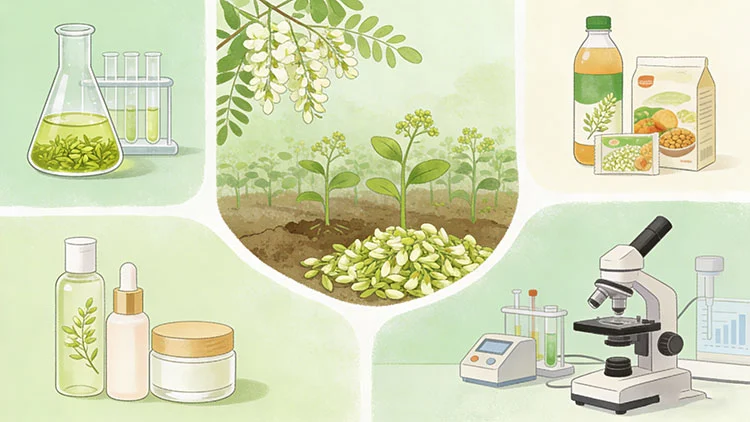
Functional Uses of Sophora japonica Extract
Industrial Functional Ingredient in Formulations
Sophora japonica extract is used as a definable source of rutin and associated flavonoids in technical formulations where standardized botanical chemistry is required. It supports formulation uniformity and easier quality control in finished products.
Ingredient in Cosmetic and Personal Care Products
In cosmetic and personal care applications, Sophora japonica extract is included for its botanical profile, which contributes to consistent appearance and texture performance in emulsions, gels, and serums. It aligns with market demand for plant‑derived inputs and can be integrated into a range of topical systems.
Use in Food and Beverage Enrichment Applications
Extracts from Sophora japonica are applied as flavor‑neutral or value‑added botanical ingredients in specialty food or beverage projects where natural flavonoid content is a desirable formulation element without causing significant impact on taste or color. For example, research has explored enrichment of honey with rutin and quercetin sourced from Sophora flowers, demonstrating creative functional ingredient applications in food matrices.
Research and Analytical Tool Development
Because rutin extracted from Sophora japonica can be highly purified, researchers have developed novel analytical tools and sensors based on its optical or chemical properties. One example is the use of rutin in preparing fluorescent sensors for metal ion detection.
Botanical Raw Material in Supply Chains
Manufacturers standardize Sophora japonica extract as a raw botanical input for other producers who require reliable flavonoid profiles for product lines. Standardization supports traceability, regulatory compliance, and cross‑batch consistency.
Practical Considerations in Formulation
Dosage and Proportioning Factors
When incorporating Sophora japonica extract into formulations, it is important to consider the concentration of defined flavonoids (e.g., rutin). This affects uniformity, texture, and physical stability, particularly in dry blends or encapsulated products. Analytical testing of raw botanical lots supports consistent dosing.
Solubility and Compatibility in Systems
The powder form of Sophora japonica extract generally dissolves readily in compatible solvents or suspends consistently in dry mixes. Compatibility testing with carriers, excipients, or ancillary ingredients helps ensure stable product performance.
Stability and Storage Conditions
Like many botanical extracts, stability of Sophora japonica extract can be influenced by environmental factors such as humidity and heat. Proper packaging and storage conditions help preserve physical integrity and maintain batch specification over time.
Industry Trends and Future Prospects
Ongoing research into extraction technologies continues to refine how rutin and other flavonoids are recovered from Sophora japonica plant material with improved yield and solvent efficiency. Greater focus on green chemistry extraction methods supports more sustainable industrial processing. As interest in plant‑derived standardized ingredients expands across consumer and technical sectors, the role of Sophora japonica extract in innovative formulations and advanced analytical applications is likely to grow.

Conclusion
In summary, Sophora japonica extract is used primarily as a standardized botanical input where consistent flavonoid composition (especially rutin) enhances formulation quality, supports product differentiation, and enables technical functionality in a range of industries from cosmetics to specialty food applications and analytical tool development.
Contact us today to learn more about our Diosmin Complex and pricing. You can send an email to info@scigroundbio.com or submit your requirements using the form at the bottom of our website.
FAQ
Q1: How is Sophora japonica extract typically processed for industrial use?
Sophora japonica extract is often prepared through optimized solvent extraction methods, including environmentally oriented deep eutectic solvents, to efficiently recover key flavonoids and produce a consistent powder form.
Q2: What types of products include Sophora japonica extract as an ingredient?
This extract is incorporated into cosmetic and personal care products, food and beverage enrichment formulations, and specialty functional mixes where defined flavonoid content is desirable.
Q3: Can Sophora japonica extract be used in analytical applications?
Yes, purified flavonoid fractions, such as rutin from Sophora japonica, have been used in preparing novel analytical sensors and optical detection systems.
Q4: What formulation benefits does Sophora japonica extract offer to product developers?
It provides a stable botanical ingredient with defined chemistry that can support uniformity, traceability, and alignment with clean‑label sourcing trends in product lines.
References
1. Le, N. T., Nguyen, T. P. D., Ho, D. V., Phung, H. T., & Nguyen, H. T. (2023). Green solvents-based rutin extraction from Sophora japonica L. Journal of Applied Research on Medicinal and Aromatic Plants.
2. Yang, S., Sun, L., Song, Z., & Xu, L. (2021). Extraction and application of natural rutin from Sophora japonica to prepare the novel fluorescent sensor for detection of copper ions. Frontiers in Bioengineering and Biotechnology.
3. [Honey with added value – enriched with rutin and quercetin from Sophora flower]. (2022). Heliyon.
4. [Total flavonoid and rutin content of different organs of Sophora japonica L.*]. (2020). Journal of AOAC International.
You may like