What is safflower powder used for?
Safflower powder is a multifunctional vegetable ingredient that is used in food, beverage, cosmetic, and industrial formulations as it provides natural color, botanical profile, and formulation versatility. When applying to product development and ingredient engineering, one needs to know what safflower powder is used for, and this can be achieved by examining how it interacts with formulations, its responses to processing conditions, and its property characteristics to the stability and performance.
Understanding Safflower Powder in Industrial Use
Plant‑Based Ingredient Integration
Safflower powder is introduced into formulations as a vegetable ingredient to promote the positioning of natural ingredients. It is used by manufacturers in products where botanical identity and recognizability are highly considered, and synthetic alternatives are undesirable. Safflower powder can be used as a dry mix in food and beverage systems, in seasoning systems, and in beverage systems based on plants to give a consistency in botanical profile.
Natural Color Contribution
The natural pigment content of safflower powder is among the most frequent reasons why it is used in formulations of products. Its flavonoid and carotenoid components give it a yellow to orange color, making it applicable in the natural coloring of dry food mixes, snack coatings, and botanical drink blends.
Functional Ingredient in Powdered Systems
In powdered systems, engineers and formulators take advantage of the fact that safflower powder is easy to flow, dispersible, and can be mixed with other excipients. Its particle size distribution, moisture content, and blending properties determine its interactions with carriers, stabilizers, and other botanical powders in more complex formulations.
Applications by Industry Sector
Food Manufacturing and Seasonings
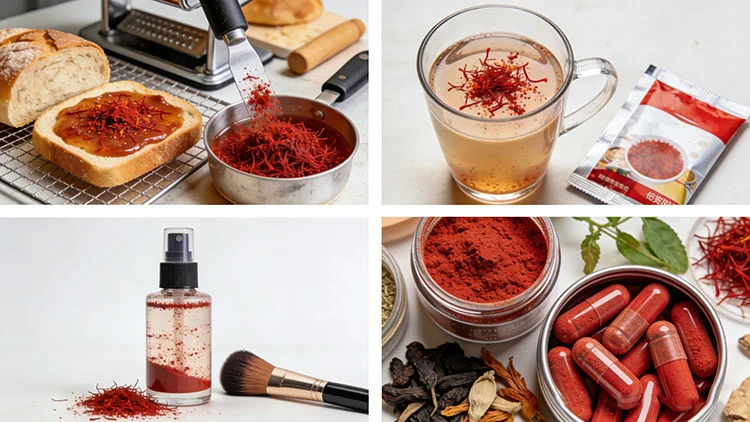
Safflower powder is also found in the food industry as a seasoning combination, dry soup blends, and plant-based meal combinations. It brings in a natural botanical touch and aesthetic outlook without artificially added substrates. Its integration degree and mixing method have to be modified in order to ensure consistency in the texture and color distribution in the end products.
Beverage and Instant Mixes
Safflower powder is used in functional beverage powders and instant drink mixes that have desired natural botanical ingredients. It is usually introduced at low usage levels and takes up proper dispersibility, which helps so that it does not clump and ensures product stability in the case of storage and reconstitution.
Cosmetic and Personal Care Formulations
Safflower powder can be utilized in cosmetic use in body scrubs, masks, and artisan soap bases because of its aesthetic and formulation value. Its compatibility with water and oil-based systems is also tested during formulation development, where it is not allowed to negatively influence sensory properties or emulsion stability.
Nutritional and Botanical Blends
Safflower powder is an ingredient complex in botanical nutrient powders and plant-based powders developed by developers. The particle size is controlled, and its quality is standardized, which is significant to provide uniform ratios of the mixes and also predictable behavior in the blending operations.
Formulation Techniques and Dosage Considerations
Blending and Particle Engineering
Particle size distribution and moisture have to be controlled when making the formulation with safflower powder. Misaligned particle size may cause segregation in blends or organize a weak stream in filling lines that are automated. Target specifications are achieved by milling and sieving methods, and uniform distribution is achieved through the optimization of blending sequences.
Stability and Storage Conditions
Humidity, temperature, and exposure to light affect the stability of safflower powder in a formulation. Color changes and water absorption can be minimized by storage in regulated conditions using proper packaging. Desiccant integration and barrier films can be adopted in the form of dry formulations in order to enhance shelf strength.
Compatibility with Other Ingredients
One of the major aspects of formulation development that will be carried out with safflower powder is compatibility testing. It is tested with carriers, buffering agents, and other botanical powders to test their influence on texture, dissolution behavior, and appearance of products. The compatibility matrices are used to assist formulators in choosing co-ingredients that facilitate the quality of the product.
Regulatory and Quality Standards
Sourcing and Traceability
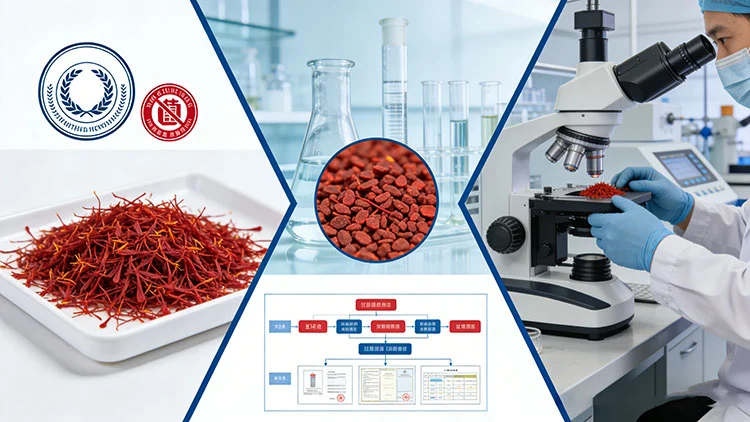
Safflower powder producers have sourcing procedures that enable them to trace and maintain the quality of the raw materials. Quality specifications usually have restrictions on moisture limits, particle size, and extraneous matter, which are checked by routine analytical analysis.
Compliance with Food and Cosmetic Regulations
The marketers who produce safflower powder should make sure that their products meet the required food and cosmetic standards in their markets. This involves compliance with the rules of ingredient labeling, the allowance of the use of such substances, and sourcing and processing documentation.
Conclusion
To conclude, safflower powder has applications in food production, beverage systems, cosmetic products, and botanical blends as a versatile ingredient. Its natural color, botanical profile, and powder characteristics make it appropriate for formulations that can focus on the use of plant-based ingredients and beauty. Knowledge of how to incorporate the safflower powder into its blending methods, storage conditions, and application specific to the industry would help manufacturers to derive maximum benefits of using this ingredient in competitive product portfolios.
Contact us today to learn more about our products and pricing. You can send an email to info@scigroundbio.com or submit your requirements using the form at the bottom of our website.
FAQ
What is safflower powder used for in food products?
Safflower powder is utilized in food items as a natural coloring, botanical pride, and formulation flexibility in seasoning blends, dry mixes, and vegetable use.
Can safflower powder be used in beverage formulations?
Yes, it is possible to add safflower powder to instant and powdered beverage mixes, where it is a natural line-label ingredient and the attribute of creating visual and sensory characteristics when it is effectively dispersed.
How does safflower powder affect formulation stability?
The physical characteristics of the safflower powder, such as the particle size and moisture content, determine the way it can combine with other ingredients, which determine the homogeneity of the blend as well as the shelf life.
In which cosmetic products is safflower powder commonly utilized?
Cosmetics Safflower powder is commonly utilized in scrubs, masks, and soap bases in cosmetics to add a visual aspect of plants to the formulation and to complement natural formulation ideas.
References
1. Smith, J. A., & Lee, P. T. (2021). Plant‑derived colorants in food applications: Stability and performance of safflower pigments. Journal of Food Science and Technology, 56(4), 1823–1832.
2. Chen, Y., & Zhao, X. (2022). Powder behavior and blending characteristics of botanical ingredients in dry mix formulations. International Journal of Powder Technology, 38(2), 99–112.
3. Martinez, L., & Gomez, R. (2023). Natural botanical powders in cosmetic formulation: Compatibility and sensory outcomes. Cosmetic Science Journal, 12(1), 45–58.
4. Williams, D., & Patel, N. (2020). Application of plant‑based powders in beverage systems: Dispersion and consumer perception. Beverage Industry Review, 15(3), 225–234.
You may like