What is nervonic acid used for?
Nervonic Acid is a specialty very-long-chain monounsaturated fatty acid for use in food and supplement formulations, lipid research, and enriched oils. The most important characteristic is the presence of C24:1 n-9.
What Is Nervonic Acid? The C24:1 Fatty Acid
Nervonic acid (NA) is a 24-carbon monounsaturated very-long-chain fatty acid (VLCFA), which is found in the brain, nervous system, and retina. Found in some plant seed oils and in biological sphingolipids. It is a component of the sphingomyelin and ceramide-related lipids, and thus it is useful in lipid analysis and in the study of ingredients. Nervonic acid, the free form of the complex lipids, does not replicate the structure of these complex lipids.
Main Uses of Nervonic Acid in Food and Supplement Formulas
Enriched oils:
Plant oils can be used as specialty lipid ingredients via standardisation. Look at the total fatty-acid profile, rather than % n-erucic acid.
Supplement formats:
For softgels, capsules, and oil-based products that require a specified fatty-acid profile, we can evaluate ingredients. Product format should comply with the requirements of the target markets.
Specialized nutrition research:
The lipid fractions, containing nervonic acid, are examined for the presence of VLCFA and sphingolipid composition. No authorization or research interest will be used for infant or specialized nutrition.
Functional foods:
Enriched oils can be tested in oil foods and oil formulations (flavor, dispersion, oxidation, and processing tests).
Lipid research:
The purified nervonic acid and its derivatives (e.g., nervonic acid ethyl ester) are used for analytical purposes. Label percentage is not a sufficient measure because there are two types of free acids: ester and non-ester.
Natural Sources and Raw-Material Selection
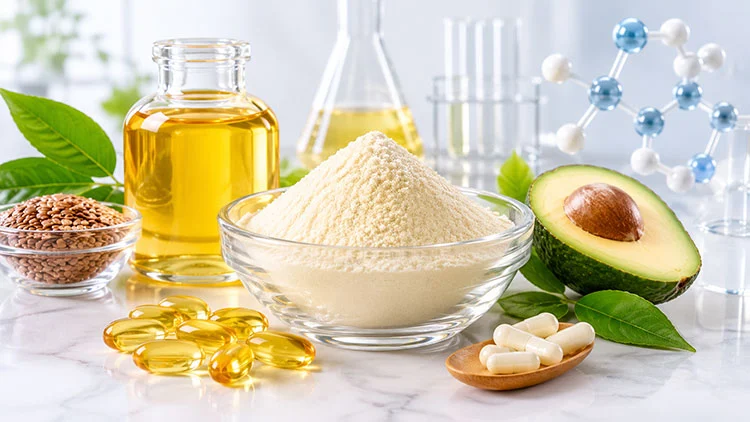
Seed oils of plants are well established, and seed oils from microbes are in the development phase. Malania oleifera, Macaranga, and Xanthoceras sorbifolium are the sources studied, while Acer truncatum is a tree that has not yet been studied. However, a study carried out in 2022 has assessed nervonic acid as 42.22% of the fatty-acid profile in Malania oleifera seed oil, not 42.22% of the whole seed.
For B2B sourcing, verify:
If the sourcing is B2B, make sure to check:
Identity: Latin name, part of plant, origin, and lot traceability.
Assay basis: As-is, dry basis, or total fatty acids, total oil, or ingredient.
Chemical form: These are different materials, including enriched triglyceride oil, free fatty acid, concentrate, and ethyl ester.
Consistency: Make a comparison of batch COAs; crop and processing can impact composition.
Formulation Methods and Ingredient Compatibility
Match method with the form of the ingredients:
Oil systems: Test and blend with an appropriate carrier to create and test oil systems for homogeneity, viscosity, clarity, and low-temperature properties. Avoid unnecessary heat.
Aqueous systems: FFA are not very water compatible. An emulsifier, pre-emulsion, or an encapsulated format might be required. Test the pH of screened lecithin or alternatives and against the full formula.
Powder blends: Test for the following properties of microencapsulated ingredients: carrier, flow, moisture uptake, dispersibility, and assay retention.
Selection of the form: Free acid, oil, glyceride-rich material, or ester – match to the product category and technical objective.
Dosage and Inclusion-Rate Factors
There is no single inclusion rate for all nervonic acid products, nor are any research focus areas consumer intake recommendations. Identify product category, Target Market, Serving Format, Applicable Requirements, and Safety Documentation first. To calculate the amount of raw material needed: Raw material needed = Target amount of nervonic acid/assay fraction. The theoretical requirement of 111 mg of ingredient, before taking process losses into account, is needed to achieve a target of 100 mg at 90% assay. This is a dosage (formulation) calculation, not a dietary recommendation. Take into consideration the carrier fatty acids and process losses, serving size, and local limits.
Stability, Storage, and Commercial Quality Checks
The nervonic acid is unsaturated, but has one double bond. The factors that influence oxidation of oil are: Oil matrix, oxygen, light, heat, trace metals, and processing. Minimize air exposure; if appropriate, use nitrogen flushing. Use opaque, oxygen- and moisture-barrier packaging and keep cool, dry, and out of the light. Determine set conditions based on stability study, as well as antioxidant compatibility and permit.
Indicate acid or peroxide value, fatty acid profile, moisture, and chemical form, assay, and method. Establish criteria for intended use for solvent, contaminant, and microbiological. Ask for batch COA, safety information, allergen statement, and stability info. Check to see if the assay is done on total fatty acids or whole oil; this will affect the formulation calculations.
To sum up, nervonic acid will be used as a special lipid ingredient, as a fatty-acid ingredient in the development of food and supplements, and as a material in lipid research. Suitability is dependent on source, chemical form, assay basis, compatibility, oxidation control, and market requirements.
You may contact us directly through the following email at info@scigroundbio.com or place your orders by filling out the form at the bottom of our site. Our team would be glad to support you with comprehensive product information, pricing choices, and OEM/ODM services to make buying a product an easy and safe process.
FAQ
1. What is nervonic acid used for in dietary supplements?
Nervonic acid is utilized as a specially formulated fatty-acid component in the formulation of a variety of supplements, including enriched oil, softgels, and capsules. It is added depending on the requirements of the ingredients, the formulation, and market regulations.
2. Which plant sources contain high levels of nervonic acid?
It is a special natural source of Malanina oleifera. Examples of other species researched include Macaranga, Acer truncatum, and Xanthoceras sorbifolium. However, the actual amount of nervonic acid in plants depends on the type of plant, its growing and extraction conditions.
3. How is nervonic acid powder incorporated into formulations?
First, the chemical form and the type of carrier in nervonic acid powder should be determined. Dry blends can be used for microencapsulated materials, and lipid systems can be used to evaluate oil-compatible microencapsulated materials. Usually, it is necessary to have an appropriate emulsification or encapsulation technology for aqueous applications.
4. Is nervonic acid stable during processing and storage?
Nervonic acid has just one double bond, but needs to be protected from oxidation. Ingredients will be affected by exposure to oxygen, light, high temperatures, and trace metals. The fatty-acid profile is important for maintaining and appropriate packaging and stability testing, are important.
5. What is the difference between nervonic acid and nervonic acid ethyl ester?
Nervonic acid is the free fatty acid, while nervonic acid ethyl ester is the esterified form of the acid. They are in different molecular forms and molecular weight so the assay results and formulation calculations are required to be done separately.
References
1. Liu, F., Wang, P., Xiong, X., Zeng, X., Zhang, X., & Wu, G. (2021). A review of nervonic acid production in plants: Prospects for the genetic engineering of high nervonic acid cultivars. Frontiers in Plant Science, 12, 626625.
2. He, X., Lu, T.-Q., Li, J.-Y., Mao, P., Zhang, L., Zheng, G.-W., & Tian, B. (2022). Germplasm resources of three wood plant species enriched with nervonic acid. Plant Diversity, 44(3), 308–315.
3. Liu, F., Wu, R., Ma, X., & Su, E. (2022). The advancements and prospects of nervonic acid production. Journal of Agricultural and Food Chemistry, 70(40), 12772–12783.
4. Ling, C., Li, F., Zhao, J., Wen, M., & Han, X. (2023). Research progress of nervonic acid biosynthesis. Journal of Oleo Science, 72(10), 889–900.
5. Yang, X., Lin, S., Chen, Y., Chen, W., Lan, D., & Wang, Y. (2024). Efficient enzymatic enrichment of high-purity nervonic acid from Malania oleifera seed oil. Journal of Oleo Science, 73(1), 99–111.
6. Phung, N. V., Rong, F., Xia, W. Y., Fan, Y., Li, X. Y., Wang, S. A., & Li, F. (2024). Nervonic acid and its sphingolipids: Biological functions and potential food applications. Critical Reviews in Food Science and Nutrition, 64(24), 8766–8785.
You may like