What is bilberry extract good for?
Bilberry extract is mostly appreciated as a high-concentration of plant-based anthocyanins and polyphenols, and has a variety of uses in dietary supplements, functional food, beverages, and cosmetic preparations. It is a valuable botanical ingredient offering manufacturers a stable pigment profile, unique composition, and flexibility of formulation due to its versatile functional properties and essential botanical properties.
Source and Extraction of Bilberry Extract
Botanical Origin: Bilberry extract is derived from fully ripened fruits of Vaccinium myrtillus, which are usually grown in Northern Europe and North America, where the fruit attains the highest phytochemical concentration.
Extraction Methods: It is extracted using modern methods of water or hydro-ethanolic extraction, then filtered, concentrated, and spray-dried to produce a fine powder that is consistent and can be used industrially.
Appearance and Stability: The extract obtained is a deep purple to reddish-violet powder, which has good powder dispersibility, capsule, tablet, and beverage applications. It is dense and therefore increases stability on the shelf and potential to mix with other ingredients.
Active Components: Anthocyanins are the predominant components, and they are facilitated by flavonoids and organic acids, which determine the functional profile of the extract and give credible pigment and compositional properties to use in formulation.
Application Methods and Formulation Tips
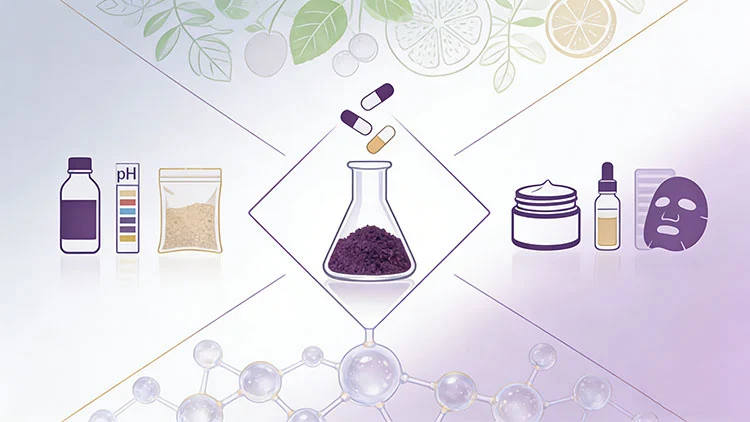
Powder Integration: Bilberry extract may be incorporated into a powder, capsule, and tablet form, optionally with anti-caking agents to maintain the homogeneity and ensure that there is no clumping throughout the processing.
Beverage Formulations: In beverages, pH balancing and stabilizers are used to preserve the color and avoid precipitation, and give the visual consistency.
Cosmetic Incorporation: Cosmetic extract is used in creams, serums, and masks to give botanical color and natural placement and is easily assimilated into base product formulations.
Microencapsulation: The encapsulation methods improve stability of the anthocyanin, pigment release, and preservation of sensitive compounds in the presence of heat or light.
Blending with Other Botanicals: Bilberry extract is compatible with other fruit powders, botanical extracts, and standard excipients, and multi-ingredient products can be formulated, in which the behavior can be anticipated.
Dosage and Standardization Considerations
Levels of Usage: It is used depending on the purpose that it aims to achieve: addition of color, enrichment of a formulation or standardization of composition, and not therapeutic goals.
Anthocyanin Standardization: Commercial extracts normally possess 25% -36% anthocyanin levels, which guarantee uniform pigment characteristics as well as functional uniformity.
Powder Flow Optimization: Powder flow and mixing can be enhanced by milling or granulation, which is essential in high-speed tableting, Capsule filling, and automated blending lines.
Batch-to-Batch Consistency: Prefabricated production guidelines ensure a consistent chemical composition, degree of color intensity, and moisture, which ensures consistent outcomes during repeated production processes.
Stability Factors and Storage
Light and heat sensitivity: the anthocyanin pigments are sensitive to light and heat, and overexposure to temperature or direct sunlight may decrease the intensity of the color.
Packaging Recommendations: Opaque, airtight containers that have desiccants should be used to avoid the exposure of the powder to moisture and environmental stress.
Ingredient Compatibility: Bilberry extract has been shown to be compatible with sugars, maltodextrin, and frequent excipients and, therefore, has a wide food, beverage, and supplement product spectrum.
Shelf Life Optimization: Stable humidity and temperature conditions in the storage environment will result in a long shelf life of the pigment and composition.
Processing: There is no degradation in the processing during spray drying or the high-speed mixing process because temperature and humidity are controlled to maintain quality during the process.

Industry Applications of Bilberry Extract
Dietary Supplements: Dietary Supplements are made under capsules, tablets, powders, and gummies due to their standardized content of anthocyanin and their vegetarian positioning.
Functional Beverages: Utilized in juices, smoothies, and ready-to-drink items to add natural color and botanical formulation attractiveness.
Cosmetics and Personal Care: Cosmetic additives to creams, masks, and serums when botanical colorants are required to be used aesthetically and position themselves as clean.
Food Industry Applications: Used in confectioneries, yogurts, snacks based on fruits, and cereal bars in order to add color, vegetable composition, and better aesthetics in formulation.
R&D and Ingredient Development: Bilberry extract is extensively utilized in non-clinical studies in stability testing, color optimization, and ingredient profiling to aid in the development of new products in the functional foods and dietary supplements.
Multi-Ingredient Formulations: It can be incorporated in complex product blends with other botanical powders and natural extracts without any interference with their flow, color, or stability.
Industrial Processing: It is in fine powder form and standard composition, and hence can be automated to undergo blending, encapsulation, and tablet processes in commercial production.
Conclusion
In short, bilberry extract is greatly appreciated due to its rich composition of anthocyanins, its stability, and its application in the food, beverage, supplement, and cosmetic industries. Manufacturers can achieve the maximum color, consistency, and functional contribution in their products by taking into consideration extraction techniques, dosage, formulation techniques, and storage conditions. Standardized quality, wide industrial applications, and ability to interact with other components make bilberry extract a dependable and high-value botanical ingredient that can be applied to fulfill the needs of modern production. By and large, it can still be a favorite among the companies that want to use pigments derived from plants as well as enhancers to their formulations.
Contact us today to learn more about our products and pricing. You can send an email to info@scigroundbio.com or submit your requirements using the form at the bottom of our website.
FAQ
Q1: How can bilberry extract be incorporated into functional beverages?
The bilberry extract may be added to juices, smoothies, or fortified beverages. The stabilizers and pH adjustments can help in maintaining the same color and prevent precipitation during storage.
Q2: What is the typical anthocyanin content in bilberry extract powders?
Typical commercial extracts are 25% to 36% standardized anthocyanins, which offer reliability of color and formulation from batch to batch.
Q3: Can bilberry extract be used in capsules and tablets?
Yes, the bilberry extract powder may be added to capsules, tablets, and powders, and usually it is added together with anti-caking agents or granulation as a means of improving flow and homogenization in manufacturing.
Q4: How should bilberry extract be stored for optimal stability?
It is necessary to preserve the integrity of pigments and the stability of the powder, so store in airtight, opaque, desiccant-containing containers, in the absence of heat, light, and moisture.
References
1. Kähkönen, M. P., et al. (2020). Anthocyanin composition and stability in Vaccinium species: implications for food and nutraceutical formulations. Journal of Food Science, 85(4), 1012–1023.
2. Prior, R. L., & Wu, X. (2021). Polyphenols in berries: standardization, processing, and industrial applications. Comprehensive Reviews in Food Science and Food Safety, 20(6), 6149–6168.
3. He, J., et al. (2022). Optimization of bilberry extract microencapsulation for improved stability and color retention. Food Hydrocolloids, 124, 107312.
4. Wang, S., et al. (2023). Formulation strategies for natural berry extracts in functional foods and beverages. Trends in Food Science & Technology, 135, 109–121.
You may like