What are the uses of amygdalin?
Amygdalin has been primarily applied in the research of botanical chemistry and also in analytical methods that are used in laboratories for the identification and quantification of plant-derived compounds, especially cyanogenic glycosides. Bitter almond, peach, apricot, and other similar plants contain a cyanogenic glycoside of known chemical structure known as amygdalin. Its applications are closely related to its chemical properties, its botanical distribution, and its behaviour in various processing operations. It is important to note that there are some accepted uses of amygdalin in analysis, but also proposed commercial uses. It is important to note the difference between approved analytical uses and proposed commercial uses of amygdalin.
Amygdalin Uses in Botanical Research
Amygdalin is a valuable compound in studying the chemical constituents of botanical materials extracted from seeds.
Characterization of chemical profile of selected fruit kernels and related plant materials: Amygdalin can be used to measure the chemical profile of selected fruit kernels and other plant material.
Variety comparison: When comparing cultivars, differences in the amount of amygdalin can be helpful to document the differences in botanical composition.
Development studies of plants: Different growth stages could be analysed to gain information about the changes in cyanogenic glycoside contents as the seeds develop.
The applications are based on the chemistry and composition analysis of plants instead of consumer benefit.
Amygdalin Uses in Analytical Testing
One of the most well-documented uses of amygdalin is for analytical testing.
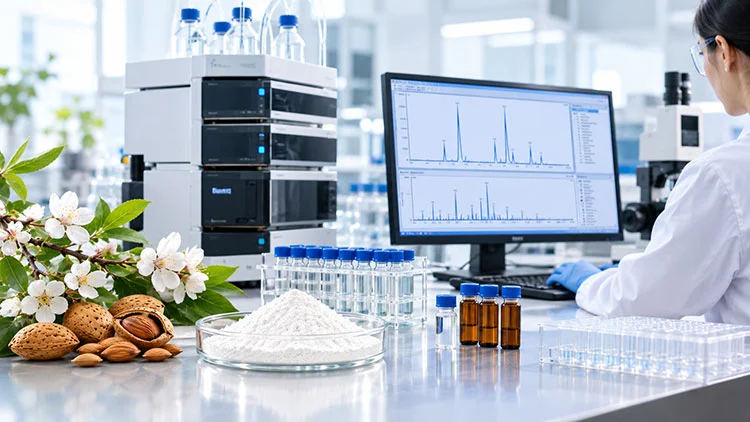
HPLC analysis: High-performance liquid chromatography separates the amygdalin from the other components of the sample and helps to quantify it.
LC-MS/MS testing: Liquid chromatography–tandem mass spectrometry is a selective identification and a very sensitive quantification method in complex botanical matrices.
Amygdalin standards, which are characterized, can be used for calibration, method verification, and laboratory quality control.
Method validation: Tests can be used to assess the accuracy, precision, recovery, and detection limits to assess if an analytical procedure is fit for purpose.
The choice of method will be determined by the type of sample matrix, the concentration expected in the sample, the required sensitivity, and availability of appropriate reference materials.
Amygdalin Uses in Enzyme Research
Amygdalin is also important for laboratory research on glycoside breakdown and enzyme activity.
Studies on β-Glucosidase: Amygdalin can be used in controlled experiments as a substrate for β-glucosidase studies.
Reaction analysis: The research can follow the changes of the amygdalin and related compounds in the process of chemical or enzymatic conversion.
The effects of process variables (temperature, pH, reaction time, and enzyme activity) can be studied to understand how they affect conversion.
These experiments should be performed with the proper safety precautions because the breakdown of amygdalin can produce hydrogen cyanide.
Amygdalin Uses in Botanical Quality Assessment
An amygdalin measure gives specific information about the composition of materials from certain seeds.
Raw material characterization: Quantitative assays determine the defined sample's measured amygdalin content.
Batch comparison: When there are differences between batches or botanical sources, they are likely to be detected by consistency of analytical methods.
Processing evaluation: It is possible to document changes in the concentration of amygdalin before and after processing.
Specifications verification: Laboratory results can be matched with content specifications declared and set acceptance criteria.
The amount of amygdalin is dependent on the botanical source, cultivar, stage of maturity, and processing. Concentrations do not indicate the quality of a botanical ingredient.
Amygdalin Uses in Extraction Method Development
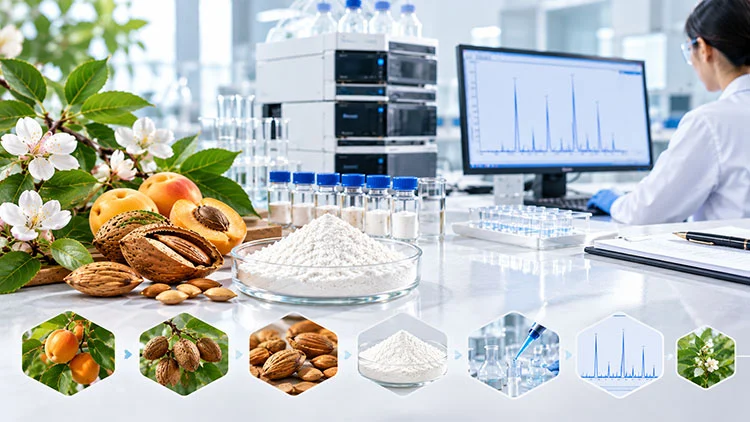
Amygdalin may be utilized in research studies on the extraction and separation of compounds found in plants.
Amygdalin recovery from different matrices: Extraction systems can be compared to assess the recovery of amygdalin from various matrices.
Optimization of extraction: The composition of the solvent, extraction temperature, extraction time, and solid-to-liquid ratio can be optimized systematically.
Sample preparation: Optimization of filtration, dilution processes, and other sample preparation procedures can minimize interference in the analysis.
Recovery assessment: Spiked samples can be used for assessing the recovery and analytical accuracy.
Laboratory extraction processes are not necessarily deemed valid processes for manufacturing.
Amygdalin Uses: Stability and Formulation Considerations
The chemical environment in which amygdalin is found needs to be carefully assessed, as in concentrated extracts or in the development of analytical solutions.
Environmental conditions such as temperature, pH, moisture, and enzymatic activity could affect its chemical activity.
Stability testing: Stability testing should be conducted for content changes on a product-specific basis, not based on a general shelf-life.
Concentration control: Documented concentrations should be used in laboratory studies that are consistent with the analytical method and/or experimental protocol.
Application suitability: Amygdalin is not a common food, beverage, or food supplement ingredient; thus, any proposed use needs to be specifically assessed for its safety and regulation.
Handling and documentation of cyanogenic reactions are important due to the potential for the release of hydrogen cyanide.
Amygdalin Uses: Emerging Technical Directions
The rest of the research work on amygdalin is more relevant to analytical science and botanical characterization.
Enhanced detection: Better chromatographic and mass spectrometric techniques can be used to facilitate more selective detection of cyanogenic glycosides.
Standardized testing can enhance comparisons between plant varieties, samples, and labs with the use of comparative botanical databases.
Process monitoring: Validated assays can track the changes in composition throughout controlled extraction and processing experiments.
These directions are indicative of opportunities for consumer research, not clear identifications of new consumer applications.
What are the uses of amygdalin?
The main applications of amygdalin are in botanical chemistry, analytical testing, enzyme research, quality assessment, and development of extraction methods. HPLC and LC-MS/MS are used to enable quantitative analysis, and controlled laboratory studies are used to investigate chemical transformation and stability. Due to the potential for release of hydrogen cyanide, the use of amygdalin in commercial applications should be carefully evaluated according to safety requirements and regulations.
To know specifications, prices, or any other customized specifications, please contact us by email at the bottom of the page, info@scigroundbio.com, or please fill in the inquiry form at the bottom of the page. Our staff will give you timely support to help with your sourcing requirements effectively and professionally.
FAQ
1. What is amygdalin mainly used for?
Amygdalin is primarily used to study botanical chemistry and for cyanogenic glycoside analysis and analytical method development.
2. How is amygdalin measured in botanical extracts?
HPLC and LC-MS/MS are proven methods for the identification and quantification of amygdalin in an appropriate sample matrix.
3. Which plants naturally contain amygdalin?
Amygdalin is found in the kernels or seeds of apricots, bitter almonds, peaches, and other plants related to peaches.
4. What affects amygdalin stability?
It may be affected by temperature and pH level, moisture, enzyme activity, and storage conditions.
5. Can amygdalin be used in food or supplement formulations?
Since the compound has cyanogenic properties and could be regulated, it is important to determine the suitability for the particular use and market.
References
1. Makovi CM, Parker CH, Zhang K. Determination of amygdalin in apricot kernels and almonds using LC-MS/MS. Journal of AOAC International. 2023;106(2):457–463.
2. Jaszczak-Wilke E, Polkowska Ż, Koprowski M, Owsianik K, Mitchell AE, Bałczewski P. Amygdalin: Toxicity, analytical procedures for its determination in plant seeds. Molecules. 2021;26(8):2253.
3. A review of recent advances in chromatographic quantification methods for cyanogenic glycosides. Molecules. 2024;29(20):4801.
4. European Food Safety Authority (EFSA). Evaluation of the health risks related to the presence of cyanogenic glycosides in foods other than raw apricot kernels. EFSA Journal. 2019;17(4):5662.
You may like