What are the sources of nervonic acid?
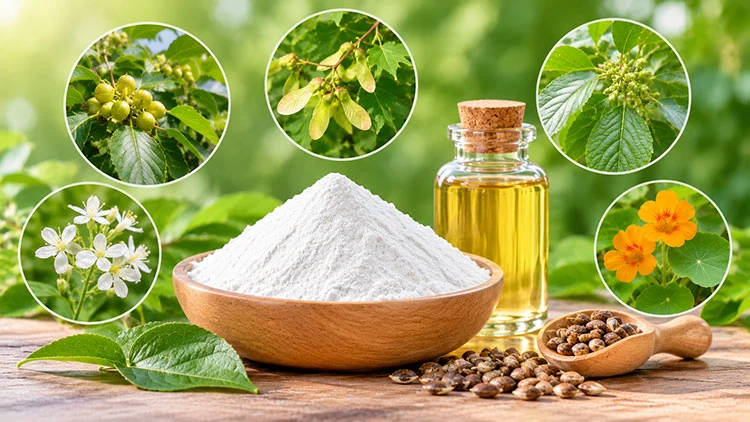
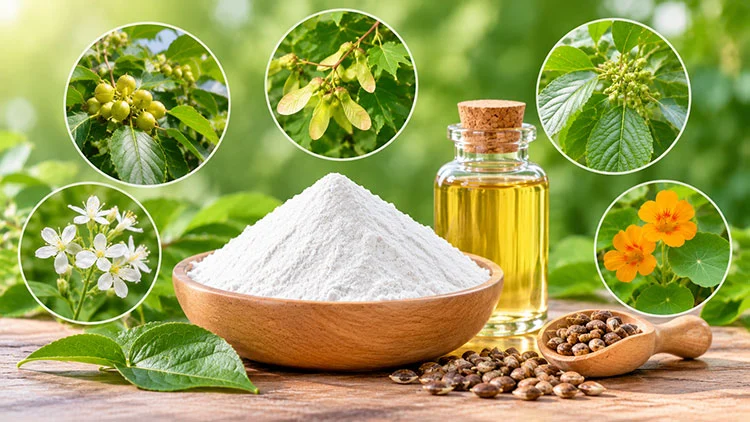
Nervonic Acid presence was confirmed in a few plant seed fats, it is also present in animal-derived fats in low quantities, with some being developed by means of microbial production. Important botanical sources are Malovania oleifera, Acer truncatum, and Macaranga spp.
What Is Nervonic Acid?
Nervonic acid is a very long-chain fatty acid (VLCFA) with 24 carbon atoms, which is monounsaturated, and contains a cis-15 double bond, commonly referred to as a cis-15 (n-9) bond, and is also known as cis-15-tetracosenoic acid. It is reported as a percentage of total fatty acids in the oil, and its presence in animal tissues is mainly in complex lipids, e.g., sphingolipids. These values do not equal the purified NA.
Major Plant Sources of Nervonic Acid
1. Malwania oleifera:
It is found in southwestern China, and its seeds are one of the richest sources of botanicals. A 2022 study determined 42.22% NA content in all the fatty acids in the kernel oil, and other kernel-oil studies have found different, and sometimes higher, NA contents. Results are influenced by the population basis, sample basis, and assay basis.
2. Acer truncatum:
It is also known as Shantung maple and is used to produce NA-containing seed oil and is being studied for oils enriched with NA; it varies in different sources and assays.
3. Macaranga species:
M. adenantha and M. indica are potential sources of woody materials, but the fatty-acid compositions of these species and populations are different.
4. Other plants:
NA is also found in Lunaria annua, Xanthoceras sorbifolium, and some species of Cardamine and Tropaeolum. The commercial value is related to the yield, concentration, and size of the cultivation.
Animal-Derived Sources of Nervonic Acid
Animal NA is most common in complex lipids.
1. Nervous tissue:
Sphingolipids containing NA are found in the brain and tissues with a high content of myelin. It used to be historically sourced from shark brain, but is impractical to be used on a regular basis due to sustainability and supply issues.
2. Milk lipids:
Human milk contains low concentrations of NA, depending on the stage of lactation and the analytical basis. This is not an industrial extraction feedstock that can be used in practice.
3. Other animal lipids:
Other animal-derived lipids, including low, have trace amounts.
Microbial Production of Nervonic Acid
As an alternative supply route, engineered oleaginous microorganisms, especially yeast platforms, are being investigated. Engineering aims at increasing fatty acid elongation and desaturation to get C24:1.
1. Fermentation:
The fatty-acid composition and lipid yield are affected by the strain and fermentation conditions.
2. Recovery:
The extraction of microbial oils involves the disruption of the cells, extraction, refining, and further enrichment of lipids.
3. Scale-up:
The validation of productivity, consistency, cost and status in regulations is needed. Oil produced by fermentation is different from oil produced from plants.
Evaluating Nervonic Acid Sources for Industrial Purchasing
A botanical name is NOT a guarantee of quality. Make sure that suppliers are compared on a level playing field.
1. Assay basis:
Verify if the NA is being reported as a % of the total fatty acids, total oil, or the whole ingredient. These values cannot be switched.
2. Oil yield:
Determine seed oil content in conjunction with NA percentage; a high fatty acid percentage does not necessarily mean that it is a high recovery per kg of seed.
3. Traceability and testing:
Check with them for the Latin name, part of the plant, location where it is grown, batch records, and fatty acid results (GC-FID or GC-MS). The COA should specify how and on what basis it is being reported.
4. Supply continuity:
Check seasonal availability and consistency of supply and specifications.
Nervonic Acid Extraction, Formulation, and Stability
The commercial materials can be either enriched seed oil, fatty-acid concentrate, purified free fatty acid, or an ester. These forms can't be replaced with a percentage indicated on the label.
1. Extraction:
Oil from the seeds can be obtained by pressing or solvent extraction. Enriching NA by hydrolysis or transesterification and then by fractionation, molecular distillation, or crystallization.
2. Formulation:
Enriched oils are adequate for use in oil blends and soft gels, while purified oils are good for analytical and special formulations. Determine compatibility of carrier and emulsifier.
3. Inclusion calculation:
The quantity of the ingredients (g) = target number of NA (g) / NA mass fraction in the ingredient (g/g). Only applies to an assay done from all ingredients. In order to be converted, a total fatty-acid percentage needs to be done with the oil's fatty-acid content.
4. Storage:
Although oxygen, light, heat, and trace metals can also have an impact on the quality of lipids, these elements are not unique to NA. Seal and protect from light and check stability in final mixes.
What are the sources of nervonic acid?
To summarize, the following are the best natural sources of nervonic acid: selected plant seed oils namely Malanina oleifera, Acer truncatum and some of the species of Macaranga. NA is found in animal tissues, especially in lipids, and is a new route through microbial fermentation. When buying the botanical, focus on B2B sourcing with a top priority on the identity of the botanical, oil yield, assay basis, recovery, batch consistency, and chemical form.
You may contact us directly through the following email at info@scigroundbio.com or place your orders by filling out the form at the bottom of our site. Our team would be glad to support you with comprehensive product information, pricing choices, and OEM/ODM services to make buying a product an easy and safe process.
FAQ
1. Which plant contains the highest concentration of nervonic acid?
Malwania oleifera is one of the most abundant documented botanical sources. It has a high proportion of nervonic acid in its seed oil, though this varies depending on the population of the plant, sample preparation, and analysis.
2. Does Acer truncatum seed oil contain nervonic acid?
Yes. The use of a plant source for the production of nervonic-acid-rich seed oil was investigated, with Acer truncatum, Shantung maple, proving to be an important source. Its oil is used for testing specialty lipids for the development of ingredients.
3. Is nervonic acid found in animal sources?
Yes. Nervonic acid is naturally found in the tissues of animals, esp. the nervous system, as a component of sphingolipids. Low concentrations are found in human milk, too. These sources are not as well suited as special plant oil sources for commercial extraction.
4. Can nervonic acid be produced through microbial fermentation?
Yes. EOP research has shown that opportunities exist for EOP systems based on engineered oleaginous yeasts. The metabolic engineering approach can be used to alter the fatty-acid synthetic pathways to boost production of C24:1.
5. How is nervonic acid extracted from plant seed oil?
Typically, these are the steps of seed preparation, extraction of oil, conversion of lipids, and purification. The oil can be extracted by pressing, solvent extraction, and further enriched by fractionation, molecular distillation, and crystallization.
6. What should buyers check when purchasing bulk nervonic acid?
Buyers are advised to check the botanical confirmation, part of the plant, fatty-acid composition, method of assay, degree of purity, method of extraction, batch consistency, and COA documentation. When making comparisons with suppliers, it is important to understand how they report the content of nervonic acid.
7. What is the difference between nervonic acid-rich oil and purified nervonic acid?
Nervonic-acid-rich oil is a source of several fatty acids, including NA, and purified nervonic acid is a single fatty-acid ingredient. They have different compositions, assay values, and formulation requirements.
References
1. Liu, F., Wang, P., Xiong, X., Zeng, X., Zhang, X., & Wu, G. (2021). A review of nervonic acid production in plants: Prospects for the genetic engineering of high nervonic acid cultivars. Frontiers in Plant Science, 12, 626625.
2. He, X., Lu, T.-Q., Li, J.-Y., Mao, P., Zhang, L., Zheng, G.-W., & Tian, B. (2022). Germplasm resources of three wood plant species enriched with nervonic acid. Plant Diversity, 44(3), 308–315.
3. Liu, F., Wu, R., Ma, X., & Su, E. (2022). The advancements and prospects of nervonic acid production. Journal of Agricultural and Food Chemistry, 70(40), 12772–12783.
4. Phung, N. V., Rong, F., Xia, W. Y., Fan, Y., Li, X. Y., Wang, S. A., & Li, F. (2024). Nervonic acid and its sphingolipids: Biological functions and potential food applications. Critical Reviews in Food Science and Nutrition, 64(24), 8766–8785.
5. Destaillats, F., Oliveira, M., Rakitsky, W., Zhou, X., & Parker, L. (2025). Nervonic acid in infant nutrition: A forward-looking approach to enhancing neurodevelopmental outcomes. Frontiers in Nutrition, 12, 1635266.
6. Li, Y., Gao, X., Gao, Z., Cao, Z., Xiong, P., & Liu, X. (2025). Sources and biological functions of nervonic acid: Advances and perspectives. Chemistry and Physics of Lipids, 273, 105554.
You may like