How to make pea protein powder?
Pea Protein Powder is obtained by cleaning, milling, separating, filtering, concentrating, drying, and quality control of yellow peas.
How Is Pea Protein Powder Made From Yellow Peas?
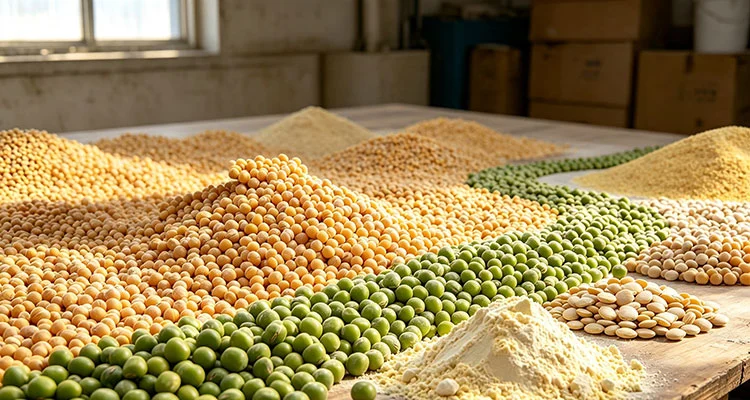
The production of pea protein powder begins with the careful selection of yellow peas (Pisum sativum L.). The peas are then preserved to extract the protein from the starch, fiber and other natural components. Typical commercial extraction methods are wet or dry extraction, depending on the protein concentration and protein functional properties required.
The simple manufacturing process of pea protein powder involves:
The selection of raw materials: The selection of raw materials is based on high-quality and suitable protein content of the yellow pea to achieve stable production performance.
Cleaning and preparation: Peas are cleaned to get rid of foreign material, and are conditioned before being processed.
Milling process: Cleaned peas are milled to produce fine pea flour to release protein-containing structures.
Protein separation: Mechanical or water based extraction is used to separate the protein fraction from the starch and fibre.
Drying process: After concentration of the protein liquid, the product is further dried by spray drying technology.
Quality Testing: The end product of pea protein powder is tested for protein, microbiological indicators, moisture, and other specifications.
The quality of the final ingredients is highly influenced by the extraction process, filtration effectiveness, drying process parameters, and raw material properties.
Raw Materials Used for Making Pea Protein Powder
The quality of pea protein powder starts with choosing the appropriate pea varieties and farming materials. Most ingredient manufacturers consider a number of factors:
The preferred yellow pea variety is one that is easier to extract protein from, and has a lighter color profile.
Protein content in raw peas: The higher the protein content, more the efficiency of extraction and yield of protein.
Raw material's purity: Low impurity levels help to process the material more smoothly and produce a consistent quality product.
Storage: Properly stored, peas enhance the functionality of protein before processing.
As a precursor to the finished product, industrial pea protein powder needs strict control of raw materials to avoid changes in pea content that can impact solubility, flavor, and processing.
Main Extraction Methods for Pea Protein Powder Production
There are two general methods used by manufacturers to extract pea protein powder: wet extraction and dry fractionation. These ingredients have different characteristics depending on the method of production.
1. Wet Extraction Method
The most popular technology available for the production of high-protein pea protein isolate powder is wet extraction.
Typically, the process consists of:
Manufacturing of flour: Peas are milled into fine flour.
Solubilization of protein: Water extraction technique used to separate protein from carbohydrate.
Filtration: Components that are unwanted are filtered or centrifuged out.
Isoelectric precipitation: Protein is separated by changing the pH conditions.
Refining of the protein fraction prior to drying - neutralisation and concentration.
Wet extraction has the following benefits:
Higher protein purity.
Improved control of end products.
Ideal for high quality PFI powder production.
2. Dry Fractionation Method
Dry fractionation has a thrust towards physical separation rather than extensive water processing.
Main steps include:
Peas being ground to make flour.
Separating particles according to size and density.
Collecting protein-rich fractions.
Dry fractionation has a number of advantages:
Lower processing requirements.
Reduced water consumption.
Some of the native pea parts remain.
But the final protein content can be different from the conventional isolate production process.
Drying and Powder Formation Process of Pea Protein Powder
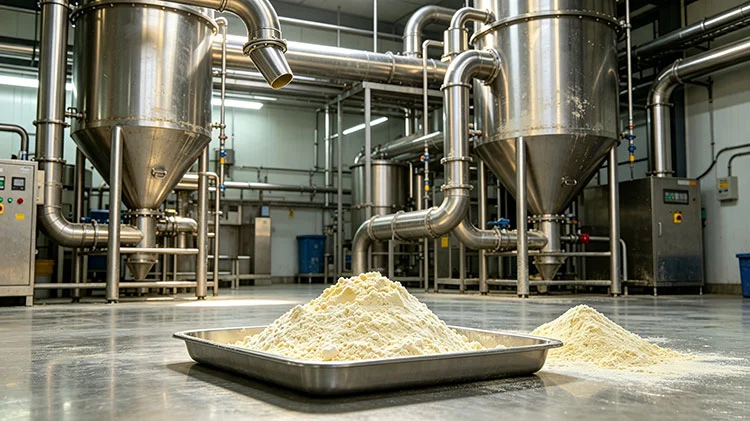
Once it has been extracted and concentrated, the liquid protein fraction has to be transformed to form stable powder. Spray drying is the most popular of the industrial drying processes.
The drying process takes place in two steps:
Atomization: Protein liquid is broken up into smaller droplets.
Water is taken away quickly: Hot air dries water out of droplets.
Powder separation/collection: Dried particles are separated and stabilized.
Production parameters are of major importance:
Drying temperature: too much heat can have an impact on the functionality of protein.
Mouthfeel: (affected by particle size)
Moisture content: Affects flow of powder and storage stability.
Solubility properties: Identifies suitability in beverages and food products.
Advanced manufacturers have optimized the drying conditions to ensure that the pea protein powder has uniform texture, appearance and application performance.
How to Improve the Quality of Pea Protein Powder?
To create a quality pea protein powder, there is more to the protein extraction process. For various end applications, functional properties should also be taken into account.
Some key improvement strategies are:
Natural pea flavor may be masked by processing, and consumer acceptance can be enhanced.
Solubility enhancement: Modification techniques can be used to enhance dispersibility in beverage systems.
Texture adjustment: Particle size control helps to obtain a smooth formulation.
Protein functionality testing: Manufacturers test for emulsification, water retention, and stability.
Formulation optimisation: Pea protein powder can be blended with rice protein or oat protein, or other plant proteins to enhance the formulation's performance.
Suppliers typically supply technical documents like a specification sheet, certificate of analysis (COA), allergen statement, and stability information for B2B ingredient applications.
Formulation Applications of Pea Protein Powder
Pea protein powder is a functional ingredient that is extensively used in different industries after production. The use depends on the protein content, the processing properties, as well as the product specifications.
Common applications include:
Protein powders: These are used as the primary protein source in protein powders.
Plant-based beverages: Added to enhance protein in beverages.
Protein bars and snacks: Give structure and enrich nutrition.
Bakery products: Used for diversifying ingredients and fortifying with protein.
Plant-based food products: Applied in the formulations of food products that need alternative protein ingredients.
As a formulation is developed, the manufacturers typically make adjustments to:
Protein inclusion ratio.
Flavor masking systems.
Sweetener selection.
Stabilizer combinations.
Processing temperature.
All of these have an impact on the taste, texture, and acceptance of the final product.
Stability and Storage Considerations for Pea Protein Powder
To ensure pea protein powder quality during transportation and long shelf life, it is necessary to properly store it.
Factors that are important for stability are:
Moisture protection: Pea protein powder should be packaged in material that prevents moisture, which should prevent it from clumping.
Powder characteristics: Maintained by moderate and dry storage conditions.
Packaging materials: Bulk ingredients are typically packaged in a multi-layer bag or a sealed container.
Regular quality test: It is a batch testing that guarantees the consistency of the produced product specifications.
Manufacturers may consider the following when deciding on how to supply ingredients internationally:
Protein percentage.
Moisture content.
Microbial limits.
Heavy metal levels.
Physical appearance.
Shelf-life stability.
How to Make Pea Protein Powder?
Pea protein powder is made in a controlled manner and is a highly concentrated protein ingredient obtained from yellow peas. The manufacturing process consists of raw material selection, milling, extraction of proteins, filtration, concentration, drying, and quality inspection. The functional properties of pea protein powders vary depending on the processing technology, enabling the development of specific protein formulations for products like beverages, sports nutrition, food products, and plant-based formulations. To ensure the production of a quality pea protein powder, it is crucial to use the appropriate extraction method and implement proper quality control procedures.
FAQ
1. What is the manufacturing process of pea protein powder?
Pea protein powder is commonly used in the production of a stable protein ingredient, and typically involves cleaning of peas, pea milling, extraction of protein, filtration, concentration, spray drying, and quality testing.
2. Can pea protein powder be made at home?
Pea protein powder can be produced at home by grinding peas into flour, or by buying it, which would need special separation and drying facilities to ensure high protein concentration and quality.
3. What equipment is used to make pea protein powder?
Typically, pea protein powder is manufactured from various industrial machines, including grinders, separators, filtration systems, centrifuges, evaporators, and spray dryers.
4. What is the difference between pea protein concentrate and pea protein isolate powder?
Pea protein concentrate generally contains a lower protein concentration and retains more pea components, while pea protein isolate powder undergoes additional purification steps to achieve higher protein content and refined functionality.
References
1. Shen, Y., Hong, S., & Li, Y. (2022). Pea protein composition, functionality, modification, and food applications: A review. Advances in Food and Nutrition Research, 101, 71–127.
2. Lam, A. C. Y., Karaca, A. C., Tyler, R. T., & Nickerson, M. T. (2021). Pea protein ingredients: A mainstream ingredient to (re)formulate innovative foods and beverages. Trends in Food Science & Technology, 109, 231–243.
3. Osen, R., Toelstede, S., Wild, F., Eisner, P., & Schweiggert-Weisz, U. (2023). Yellow field pea protein (Pisum sativum L.): Extraction technologies, functionalities, and applications. Foods, 12(21), 3978.
4. Mukherjee, A., et al. (2024). Pea protein extraction method impacts the protein (micro)structural organisation and in vitro digestion kinetics. Food & Function, 15, 1845–1858.
5. Mathew, S., et al. (2024). On treatment options to improve the functionality of pea protein. Journal of the American Oil Chemists' Society.
You may like