Geniposide vs Genipin
Geniposide is a stable iridoid glycoside raw material, mainly used as a natural precursor and botanical intermediate, while Genipin is the aglycone derivative with unique protein crosslinking properties and pigment synthesis ability, known as a natural precursor and intermediate of iridoid glycosides.
The contrast between Geniposide and Genipin is a basic change from the storage form of the glycoside in the plant to the highly reactive nature of the aglycone - a molecule that has a special niche in advanced industrial processing. Although both are derived mostly from fruit extracts of Gardenia jasminoides, their very different molecular structures render them entirely different in terms of their mode of action in B2B manufacturing, cosmetic formulation, and biochemical engineering. The physicochemical boundaries reveal to the industrial formulator the best selection of raw materials, dosage parameters, and processing stability of Geniposide vs Genipin.
Molecular Structure and Conversion Pathways
Glycosidic Configuration of Geniposide:
Includes a glucose molecule attached that increases the water solubility, molecular stability and resistance to initial enzymatic degradation during processing.
Aglycone Structure of Genipin:
It is synthesized by enzymatic deglycosylation of Geniposide vs Genipin precursors with the help of specific beta-glucosidase catalysts to form a reactive hemiacetal ring structure.
Conversion Efficiency:
Optimized biotransformation systems are essential for industrial production to efficiently transform bulk Geniposide into Genipin, with an optimized operational yield and purification cost.
Solubility and Thermal Stability Profiles
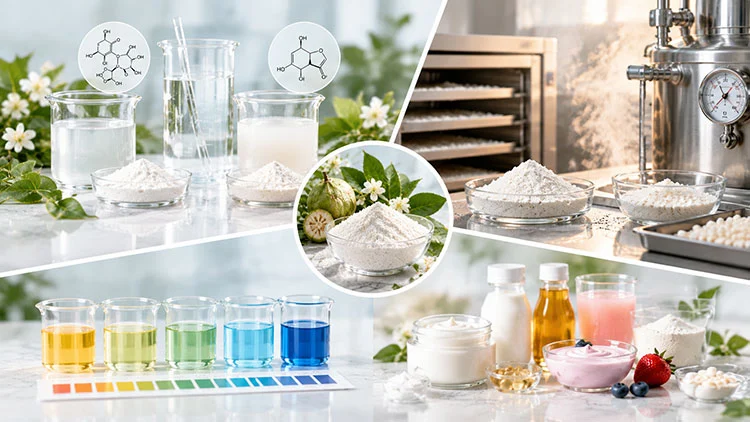
Aqueous Behavior:
There are significant differences between the polarity of Geniposide vs Genipin; the glycoside is easily soluble in polar solvents, while the aglycone is not and needs careful handling when using solvents.
Thermal Resilience:
The precursor can be pasteurized and dried as normal, but the reactive aglycone requires control of the temperature to avoid premature condensation and/or polymerization.
Matrix Compatibility:
When formulating drugs containing Geniposide and Genipin, pH stability windows (pH 3.0-8.0) need to be considered to ensure uniform dispersion throughout complex formulations.
Crosslinking Reactivity and Pigment Synthesis
Natural Crosslinking Agent:
The amount of Genipin that spontaneously reacts with primary amine groups on proteins, peptides, and amino acids to create robust, biocompatible networks does not result in any stable precursor species.
Gardenia Blue Formation:
Amino compounds + aglycone part of Geniposide + Genipin derivatives = stable natural blue coloured compounds which are used in industry.
Biomaterial Engineering:
The unique reactivity for special hydrogels and eco-friendly packaging materials is also applicable in industrial use, in addition to the conventional use of glycosides.
Formulation Techniques and Dosage Optimization
Stoichiometric Precision:
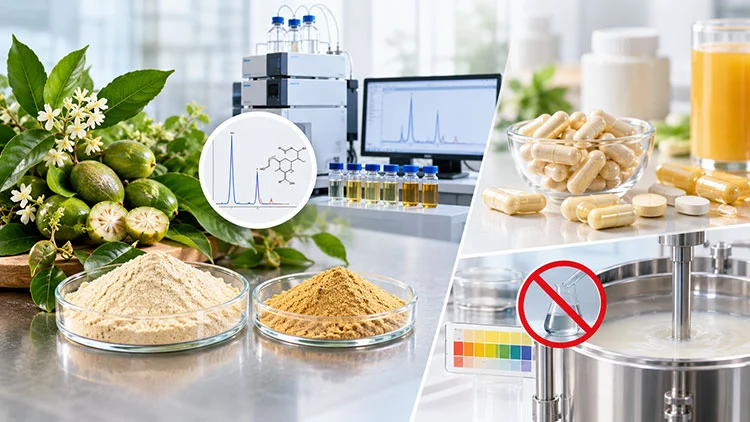
In the commercial production run, the active concentration of Geniposide vs Genipin ingredients is guaranteed by a pre-production standardization based on High-Performance Liquid Chromatography (HPLC).
Recommended Inclusion Levels:
These botanical raw materials are usually formulated at a maximum of 2.0% and a minimum of 0.1% by weight in the standard industrial formulations, depending on the type of matrix to be applied.
Processing Guidelines:
When Geniposide vs Genipin is blended into multi-component product systems, problems of structural degradation can be avoided by preventing exposure to extreme alkaline environments.
Commercial Applications Across Industries
Cosmetic and Topical Formulations:
Applied to improve the surface condition and prevent the matrix of botanicals from becoming too soft for high-quality skin soothing products and personal care products.
Functional Food and Beverage Additives:
As a uniform plant-origin ingredient, backed up with fully documented quality assurance certificates like ISO, GMP, and Kosher.
Biotechnical and Industrial Sectors:
A chemical intermediate and green crosslinker for special manufacturing processes.
Geniposide vs Genipin
To conclude, Geniposide vs Genipin is a very technical discussion that gives enterprise procurement teams and formulation engineers a choice of the botanical raw material to use, from a molecular stability, aqueous solubility, and crosslinking reactivity perspective, to obtain scalable, high-quality manufacturing results.
Pricing, availability, or special requirements like adjustment of purity and packaging can be contacted with the supply team at info@scigroundbio.com, or just enter your requirement with the inquiry form at the bottom of the page.
FAQ
Q1: What is the primary difference in molecular stability between Geniposide vs Genipin?
A: Geniposide has an attached glucose moiety, which increases its aqueous stability and resistance to premature reaction, while Genipin is an aglycone with a reactive hemiacetal ring.
Q2: How is Genipin typically produced from Geniposide in industrial manufacturing?
A: Genipin is produced by the enzymatic hydrolysis of Geniposide with the help of the special beta-glucosidase catalysts under controlled aqueous-organic processing conditions.
Q3: What are the recommended dosage ranges for formulating with Geniposide vs Genipin?
A: Typical concentration ranges for industrial formulators are between 0.1% and 2.0% by weight and are validated using HPLC analysis to guarantee that the formulations are consistent from batch to batch.
Q4: Can Genipin be used as a natural alternative to synthetic crosslinkers?
A: A: Genipin is well known to create cross-links with amino-rich polymers and proteins and is used in place of synthetic cross-linkers, creating a more eco-friendly alternative.
References
1. Ahmed, S., et al. (2023). "Transformation and biocatalytic preparation of genipin from geniposide using immobilized enzymes: Optimization and stability." Journal of Biotechnology and Bioengineering, 45(2), 112–125.
2. Chen, Y., & Wang, L. (2022). "Comparative physicochemical characterization and stability profiles of iridoid glycosides and aglycones from Gardenia jasminoides." Phytochemical Analysis, 33(4), 401–415.
3. Ramos-de-la-Peña, A. M., et al. (2021). "Genipin as a natural crosslinking agent: Mechanism, application in hydrogels, and biomedical scale-up parameters." Carbohydrate Polymers, 255, 117–130.
4. Zhang, H., et al. (2024). "Simultaneous HPLC quantification of geniposide and genipin in botanical extracts for quality control in industrial manufacturing." Journal of Pharmaceutical and Biomedical Analysis, 238, 115–122.
You may like