Geniposide Uses
Geniposide applications focus on the functional role of a standardized active raw material and chemical intermediate, commonly used in cosmetic formulations, functional food production, development of nutraceuticals, and special biotechnological processes.
Today's industrial context of Geniposide Uses has grown significantly, and commercial brand owners, chemical engineers, and product formulators are looking for reliable natural ingredients with bioactive properties from plants. Gardenia jasminoides Ellis geniposide is the major compound extracted from the ripe fruits of Gardenia jasminoides Ellis and is highly water-soluble, molecularly stable, and has good compatibility with a variety of production systems. This knowledge of technical execution, formulation parameters, and operational boundaries enables enterprise teams to ensure maximum batch consistency, optimize cost efficiency, and create innovative products that align with corporate sustainability objectives.
Primary Formulation Techniques for Geniposide Uses
Aqueous Phase Integration:
With its polar glycosidic structure, geniposide is instantaneously soluble in the aqueous part of a liquid or emulsion formulation, eliminating the necessity to use high-shear dispersion.
Hydroalcoholic Solvent Systems:
Hydroalcoholic carrier (10% - 30% ethanol) is used for the liquid botanicals and cosmetic toners to keep them optically clear for extended periods and to inhibit microbial growth.
Low-Temperature Blending Protocols:
When using a large production scale, geniposide should be added at cool down stage (below the temperature of 50℃), which is the stage to avoid unnecessary thermal stress.
Critical Processing Stability and Environmental Factors
Thermal Endurance Profile:
When stored within normal processing ranges, geniposide is very stable in conventional thermal pasteurization and spray drying conditions.
pH Sensitivity Boundaries:
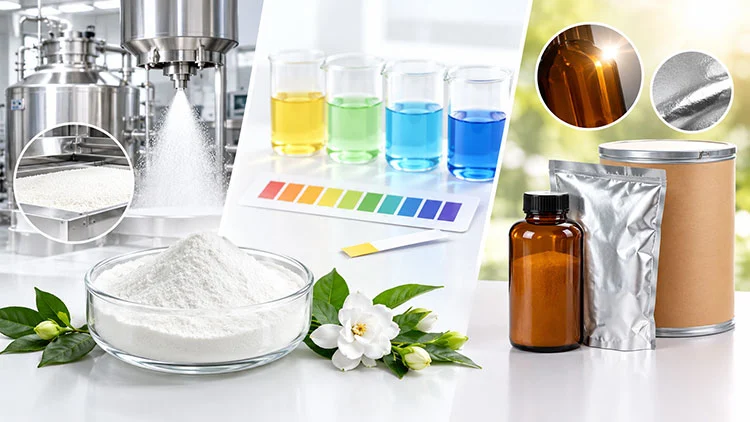
Formulations containing Geniposide are most effective in the range of pH 3.5–7.5, because extreme acidity or basicity will cause a slow hydrolysis of the glycosidic bonds.
Light and Oxidation Controls:
Light barrier containers (amber glass or aluminum foil drum) should be included in industrial packaging to protect raw geniposide powder against photodegradation in long-term storage.
Dosing Parameters and Concentration Guidelines
Topical Personal Care Inclusion:
Typical industrial applications are from 0.1% to 0.8% of total formula in skin-soothing matrices, personal care lotions, and cosmetic serums.
Functional Nutrition Matrices:
The inclusion rates for commercial beverage and dietary supplement use of standardized geniposide raw material range from 0.05% to 0.5%, as specified.
HPLC Standardization Requirements:
For enterprise B2B purchasers, the only method to ensure a consistent stoichiometry between different batches from the bulk manufacturing is to depend on assays using High-Performance Liquid Chromatography (HPLC).
Diverse Industrial Applications and Sector Integration
Cosmetics and Personal Care:
Frequently added to antioxidant facial gels, facial masks, and barrier-support skin care products thanks to its natural antioxidant activity as well as its physiological compatibility.
Functional Foods and Beverages:
A clean label botanical active ingredient for functional energy shots, hydration mixes and botanical wellness teas.
Natural Pigment Precursor Manufacturing:
As a basic raw material, it is used for the production of Gardenia Blue and Gardenia Red natural colourants by enzymatic reaction, which are used globally in the food and beverage industries.

Geniposide Uses
To wrap up, Geniposide Uses have been discovered in a number of commercial fields, making it an assured, highly soluble botanical active compound with excellent thermal stability and easy process integration for creating high-performance product designs.
Pricing, availability, or special requirements like adjustment of purity and packaging can be contacted with the supply team at info@scigroundbio.com, or just enter your requirement with the inquiry form at the bottom of the page.
FAQ
Q1: What are the main industrial applications associated with Geniposide Uses in cosmetics?
A: In topical cosmetic products, geniposide is mainly employed because of its natural skin-soothing effect, its antioxidant activity and because of its benefits for maintaining the moisture barrier balance in soothing creams and serums.
Q2: How does temperature affect the stability of Geniposide Uses during food manufacturing?
A: The thermal stability of geniposide is good in standard pasteurization and flash-heating processes, but the compounds present in it may be degraded if the temperature exceeds 80°C for a long time at extreme pH conditions.
Q3: What solubility characteristics should formulators know regarding Geniposide Uses?
A: The water solubility of geniposide is very high; it can be dissolved well in aqueous media, glycerols, and hydroalcoholic mixtures, so there is no need to add synthetic solubilizers or use harsh organic solvents in liquid batching.
Q4: Is Geniposide suitable for clean-label botanical product development?
A: Pure geniposide powder is extracted from natural Gardenia jasminoides fruit, which meets international clean label, non-GMO, and ISO/GMP production processes and standards, suitable for global distribution.
References
1. Liu, Y., Zhang, X., & Chen, M. (2022). "Extraction, purification, and stability characterization of iridoid glycosides from Gardenia jasminoides Ellis for industrial applications." Journal of Food Process Engineering, 45(3), e13982.
2. Wang, H., Zhou, J., & Li, R. (2021). "Enzymatic conversion of geniposide to value-added bio-based compounds and pigments: A technical review." Process Biochemistry, 108, 145–156.
3. Zhao, Q., Sun, L., & Xu, K. (2023). "Formulation stability and physicochemical behavior of plant-derived iridoid glucoside active ingredients in topical emulsions." International Journal of Cosmetic Science, 45(2), 201–212.
4. Patel, K., & Patel, D. K. (2020). "Technological advancements in the isolation and industrial utilization of geniposide from natural botanical sources." Phytochemical Analysis, 31(6), 721–733.
You may like