Amygdalin function
Amygdalin is a naturally occurring cyanogenic glycoside in plants and is being researched in botanical chemistry and enzyme and analytical testing. Amygdalin is mainly found in apricot kernels, bitter almonds, and other related seeds, and has a known chemical structure, which governs its reactions and breakdown. For a better understanding of the function of amygdalin, it is essential to explore the role of amygdalin in plant chemistry, interaction with enzymes, and technical aspects that influence the analysis, stability, and handling of amygdalin.
Amygdalin Function in Plant Chemistry
Amygdalin is a member of a class of special metabolites found in some species of the Rosaceae family.
Plant defense research: Cyanogenic glycosides are investigated for their role in plant chemical defense, as they can release hydrogen cyanide when exposed to certain conditions.
Comparative studies of seed composition can be made on the basis of amygdalin content in different species and cultivars of plants.
Developmental analysis: Measurement of amygdalin throughout growth stages is useful for studying the changes in the plant metabolite profile.
The concentration is dependent on the botanical variety, maturity, growing conditions, and processing history.
Amygdalin Function in Enzymatic Reactions
Amygdalin can be enzymatically hydrolysed, so it is useful in glycoside transformation studies.
Enzyme interaction: Some of the β-glucosidases can start to break the structure of amygdalin by cleaving off the glycosidic bond.
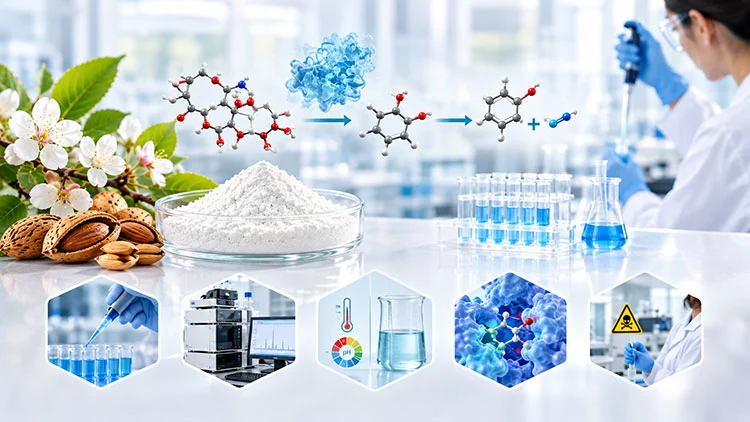
Reaction pathways: Prunasin can be an intermediate in the process, followed by additional breakdown, which could yield benzaldehyde and hydrogen cyanide.
The influence of temperature, pH, enzyme activity, and reaction time on conversion behavior is considered.
The reactions are a basis for investigating enzyme activity and chemical transformation. Hydrogen cyanide is very toxic, and experiments involving it should have safety measures in place.
Amygdalin Function in Analytical Chemistry
The known chemical structure of amygdalin makes it a convenient compound for botanical analysis.
HPLC quantification: Amygdalin is separated from other components of the sample using HPLC, thus allowing the concentration to be measured.
LC-MS/MS identification: Tandem mass spectrometry can be used to increase the selectivity of analysis of complex botanical extracts.
Characterized standards: Standards that are used for calibration, analytical verification, and in the laboratory for quality control.
Method validation: Accuracy, precision, recovery, and detection limits are used to determine if a method is fit for purpose.
The analysis method will depend on the type of sample, concentration of sample, and the sensitivity required.
Amygdalin Function in Botanical Quality Assessment
Amygdalin measurements deliver particular measurements of the make of picked seed-based materials.
Content verification: Quantitative testing gives a concentration of amygdalin in a sample that is measured.
Batch comparison: Batch comparison is possible with a consistent analytical method, which allows identification of compositional differences between batches.
Evaluation by processing – Tests can be conducted before and after processing and record changes in amygdalin content.
Botanical profiling: Complementary information can be derived from the results of amygdalin and other chemical markers.
Concentration of amygdalin is only a part of the quality and safety assessment of a botanical ingredient.

Amygdalin Function in Extraction Research
Amygdalin is also important for research on extracting and measuring compounds from plants.
Evaluation of Amygdalin Recovery from Different Botanical Materials using Different Extraction Systems.
Analytical recovery may be influenced by process optimization such as the composition of the solvents, extraction time, temperature, and solid-to-liquid ratio.
Preparation of samples for measurement: Filtration and matrix clean-up can minimize interference during measurement.
Recovery studies: Spiked samples can be used to estimate the efficiency of the extraction process, as well as any analytical losses.
Special extraction procedures in the laboratory need to be validated before use for commercial-scale extraction.
Amygdalin Function and Stability
The stability of amygdalin is dependent on the chemical environment and conditions.
Stability testing and sample preparation should be carried out in a controlled environment: temperature and pH.
Enzymatic activity: Enzymes that can hydrolyze the amygdalin might alter its composition.
Storage conditions: The storage conditions should be judged based on product-specific data, including moisture, packaging, light exposure, and temperature.
Content monitoring: Methods validated by analysis can be used to monitor changes during storage and to determine compliance with a defined specification.
When determining shelf life, the data should be based on the stability of the material and not on assumptions of botanical ingredients.
Amygdalin Function in Specialized Research
The most obvious analytical and controlled laboratory uses of amygdalin are yet to come.
Glycoside profiling: Amygdalin may be determined in conjunction with other compounds to characterize botanical samples.
Optimization of the analytical method: Chromatographic procedures can be optimized for greater selectivity and quantitative reliability.
Chemical transformation studies: Experiments can be carried out under controlled conditions to examine changes that occur in the chemical reaction or the enzyme reaction.
Amygdalin is not a common food, beverage, or dietary ingredient. It has the potential to emit hydrogen cyanide, so it needs to be assessed carefully for safety, and regulations apply before any use is suggested in a commercial setting.
Amygdalin function
The main chemical activity that is associated with amygdalin function are enzyme mediated reaction, chemical process and lab analysis. The structure is well defined and makes it an optimal material for research of its botanical composition, cyanogenic glycoside measurement, and chemical transformation. Its concentration can be evaluated by analytical methods like HPLC and LC-MS/MS, and stability and changes due to processing can be determined by controlled testing. However, suitable safety precautions and regulatory approval are still necessary, as it may liberate hydrogen cyanide.
To know specifications, prices, or any other customized specifications, please contact us by email at the bottom of the page, info@scigroundbio.com, or please fill in the inquiry form at the bottom of the page. Our staff will give you timely support to help with your sourcing requirements effectively and professionally.
FAQ
1. What is the primary function of amygdalin in plants?
Amygdalin is a cyanogenic glycoside that has been studied as a part of plant chemical defense and specialized plant metabolism.
2. How does amygdalin react with enzymes?
Some β-glucosidases are able to degrade amygdalin in a sequential manner, which can generate hydrogen cyanide.
3. How is amygdalin measured in botanical extracts?
Amygdalin can be identified and quantified in appropriate matrices by HPLC and LC-MS/MS.
4. What factors affect amygdalin stability?
It may be chemically unstable under some conditions such as temperature, pH, moisture, enzymatic activity, and storage conditions.
5. Can amygdalin be used in food formulations?
It can't be assumed to be safe to use due to the possibility of amygdalin converting to hydrogen cyanide. All intended uses must be evaluated for safety and regulation on an application-by-application basis.
References
1. Jaszczak-Wilke E, Polkowska Ż, Koprowski M, Owsianik K, Mitchell AE, Bałczewski P. Amygdalin: Toxicity, analytical procedures for its determination in plant seeds. Molecules. 2021;26(8):2253.
2. Makovi CM, Parker CH, Zhang K. Determination of amygdalin in apricot kernels and almonds using LC-MS/MS. Journal of AOAC International. 2023;106(2):457–463.
3. Zhao Y, et al. A review of recent advances in chromatographic quantification methods for cyanogenic glycosides. Molecules. 2024;29(20):4801.
4. EFSA Panel on Contaminants in the Food Chain. Evaluation of the health risks related to the presence of cyanogenic glycosides in foods other than raw apricot kernels. EFSA Journal. 2019;17(4):5662.
You may like